History of Astrology: From Mesopotamia to the Digital Age
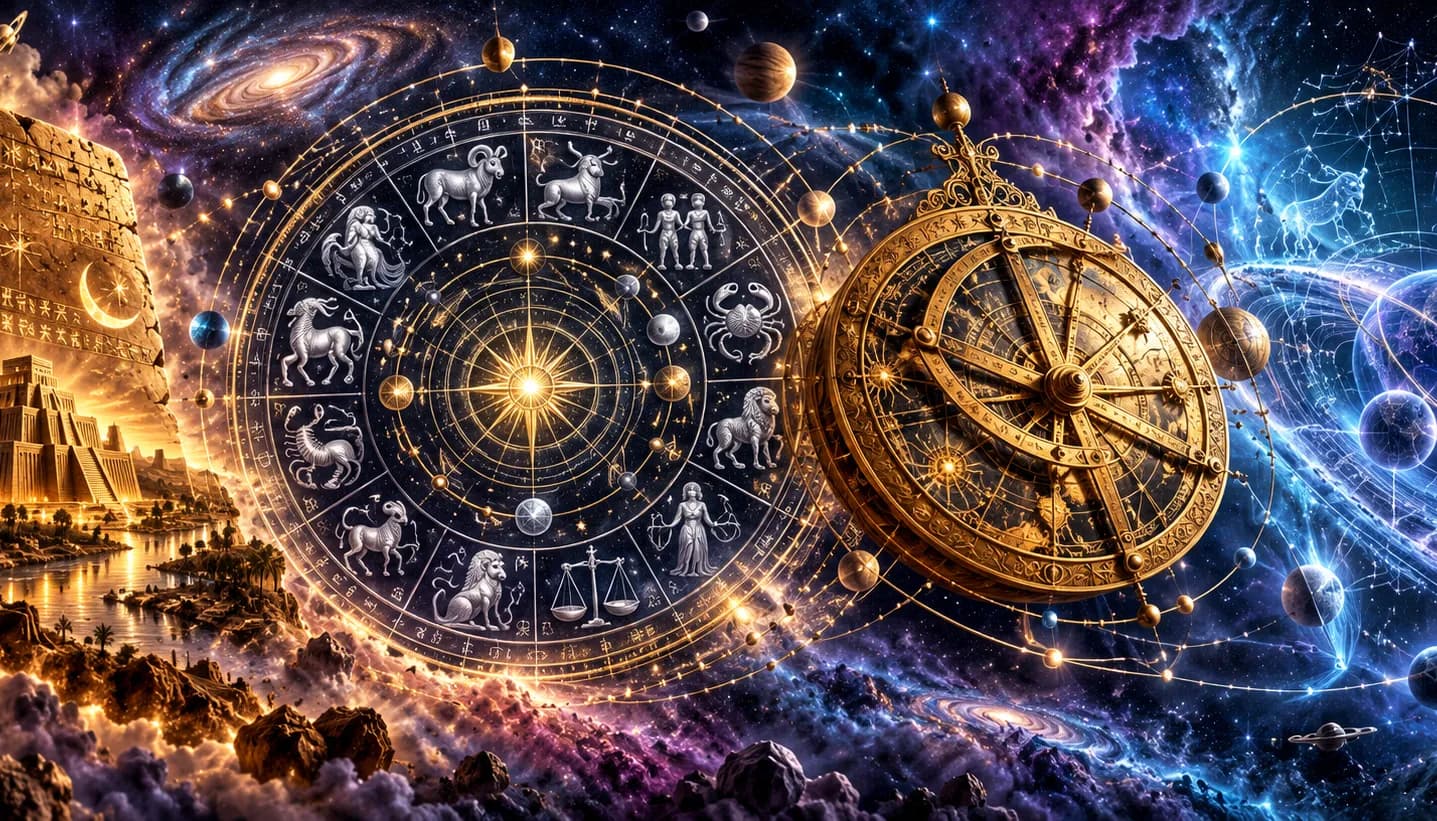
The natal chart you can pull up in seconds today is the result of more than two thousand years of observation, translation and reinterpretation. At Aspectados we generate natal charts with artificial intelligence, and behind every calculation lie techniques with a very long lineage. In this overview, we explain where each one comes from.
What astrology has meant throughout history
Astrology has not meant the same thing in every era. Its function has changed over time, and it helps to keep that in mind if you want to read it with a critical eye:
- Symbolic language: a way of organizing and making sense of what is observed in the sky.
- Calendar and omen tool: in antiquity, celestial cycles were linked to the seasons, the harvests and the affairs of the kingdom.
- Individual system: since the Hellenistic period, the moment of birth has been used to describe a specific person.
- Framework for self-knowledge: in the 20th century it shifted toward psychology and personal growth.
- Symbolic practice, not experimental science: today it is understood as a language for reflection, not as a way to predict events with certainty.
Mesopotamia: from recording celestial omens to the zodiac
Observing in order to interpret
Babylonian astrology grew out of a systematic practice of observation. Mesopotamian scribes spent centuries noting eclipses, planetary appearances and lunar phases on clay tablets. These records were gathered into series such as the Enūma Anu Enlil, a vast collection of celestial omens. Other texts, such as the MUL.APIN, catalogued stars, constellations and the paths of the heavenly bodies.
At this stage the focus was on the king and the state. Celestial phenomena were read as signs about the country, not about an individual's life.
The twelve-sign zodiac
The origin of the zodiac as we know it is placed in Babylon, toward the end of the 5th century BCE. Astronomers divided the band of sky through which the Sun, the Moon and the planets travel into twelve sectors of 30° each. This produced a regular unit of measurement, useful for calculating positions.
From roughly the same period come the earliest known natal horoscopes, tablets recording planetary positions at the time of a birth. They were not yet complete interpretive charts, but they laid the groundwork.
Hellenistic astrology: Egypt, Greece and the birth of the natal chart
A crossroads of cultures
After the conquests of Alexander the Great, cities such as Alexandria became meeting points. Babylonian astronomy, Greek philosophy and Egyptian traditions came together there, including the division of the signs into 10° decans. From this blend emerged Hellenistic astrology, which developed between the 2nd century BCE and the 6th century CE.
The foundational techniques
The great innovation was the shift from collective omens to the individual natal chart. This period left us tools we still use today:
- The Ascendant, the sign rising over the eastern horizon at the moment of birth.
- The houses, which divide the chart into twelve areas of life. In this period they were calculated by whole signs.
- The aspects between planets, based on geometric relationships between signs.
- The dignities: domicile, exaltation and other ways of measuring a planet's strength.
- The Lots (such as the Lot of Fortune) and profections, annual predictive techniques.
Authors such as Manilius, Dorotheus of Sidon, Vettius Valens and Firmicus Maternus preserved much of this knowledge in their treatises.
Ptolemy and the systematization of the tradition
In the 2nd century, the Alexandrian scholar Claudius Ptolemy wrote two influential works: the Almagest, on astronomy, and the Tetrabiblos, devoted to astrology. His aim was to give the discipline an explainable foundation, grounded in the natural philosophy of his time.
In the Tetrabiblos, Ptolemy:
- Describes the nature of the planets using the classical qualities (hot, cold, moist, dry).
- Classifies the signs as cardinal, fixed and mutable, and by element.
- Develops the aspects as geometric relationships between signs.
- Works with the tropical zodiac, anchored to the equinoxes and solstices, which is the one used by Western astrology today.
His work does not summarize the whole Hellenistic tradition, but it did put it in order and left it in a form that was easy to copy, translate and comment on.
Arabic, medieval and Renaissance transmission of the techniques
The Arabic bridge
From the 8th century onward, in the Islamic world and especially in Baghdad, Greek, Persian and Sanskrit texts were translated into Arabic. Astrologers such as Masha'allah, Abu Ma'shar and Al-Qabisi commented on and expanded the tradition. This period saw the development of the Arabic parts (an evolution of the Lots), annual revolutions and electional astrology, which chooses the most favorable moment to begin something.
Medieval Europe
Between the 12th and 13th centuries, these works were translated into Latin, largely from centers such as Toledo. Astrology entered the university setting alongside astronomy and was taught as a prestigious field of knowledge. Guido Bonatti, in the 13th century, compiled a widely cited treatise on the practice. This period consolidated medieval astrology and horary astrology, which answers questions based on the moment they are asked.
The Renaissance
The Renaissance recovered ancient sources and spread them through the printing press. New house division methods appeared, such as those associated with Regiomontanus and, later, Placidus. Kepler worked with aspects and horoscopes, and in 1647 William Lilly published Christian Astrology, a landmark of horary astrology in English.
With the scientific revolution and the heliocentric model, astrology gradually lost its place in the universities during the 17th and 18th centuries.
From 20th-century psychology to digital and AI astrology
From symbol to self-knowledge
Modern astrology re-emerged between the 19th and 20th centuries. Alan Leo, linked to Theosophy, popularized a reading centered on character. Later, the psychology of Carl Jung, with ideas such as archetypes and synchronicity, inspired authors like Dane Rudhyar, who proposed a humanistic astrology oriented toward personal growth.
During this stage, Uranus (discovered in 1781), Neptune (1846) and Pluto (1930) were added to interpretation. In the 1930s, newspaper horoscopes based on the Sun sign also became widespread.
Revival and the digital era
Starting in the 1990s, numerous Hellenistic texts were translated into English, which revived interest in the original techniques. At the same time, digital ephemerides and software meant that calculating a chart was no longer hours of manual work.
Today, artificial intelligence lets you explore your chart through conversation, asking about each placement. It is a new layer of access to an ancient tradition, not a substitute for personal judgment.
Which of today's techniques we inherit from each era
If you want to trace the origin of what you see in your chart, this summary works as a guide:
- Mesopotamia: the twelve-sign zodiac of 30° each and the systematic observation of planets and eclipses.
- Hellenistic period: Ascendant, houses, aspects, dignities, Lots and profections.
- Ptolemy: classification by elements and modalities, and the tropical zodiac.
- Arabic and medieval tradition: Arabic parts, annual revolutions, electional and horary astrology.
- Renaissance: house systems such as Regiomontanus and Placidus.
- 20th century: psychological reading, modern planets and the popular Sun sign.
To make the most of this heritage, calculate your chart at Aspectados and see which elements you recognize: the Ascendant, the houses or the aspects. Then you can ask the AI where each technique comes from and how it is interpreted, always as a tool for reflection.
Conclusion
The history of astrology is a history of translations: from Babylonian tablets to Alexandria, from Baghdad to Toledo, and from printed treatises to today's apps. Knowing that journey helps you read a natal chart with more context and fewer clichés. If you want to put it into practice, generate your chart at Aspectados and talk with it to discover which ancient technique lies behind each symbol.