What Is a Birth Chart and How Do You Read It? A Complete Beginner's Guide
What Is a Birth Chart: Your Cosmic Instruction Manual
If you have ever wondered what a birth chart actually is and why so many people are talking about them, you are in the right place. Beyond daily horoscopes and Sun sign generalizations, the birth chart is the most complete and precise tool astrology offers for understanding who you are, why you behave in certain ways, and where your life is heading.
In this guide, we will break down every component of the birth chart in clear, accessible language, so that even if you have never read a single word about astrology, you will walk away understanding how this fascinating celestial map works.
Definition: What Exactly Is a Birth Chart
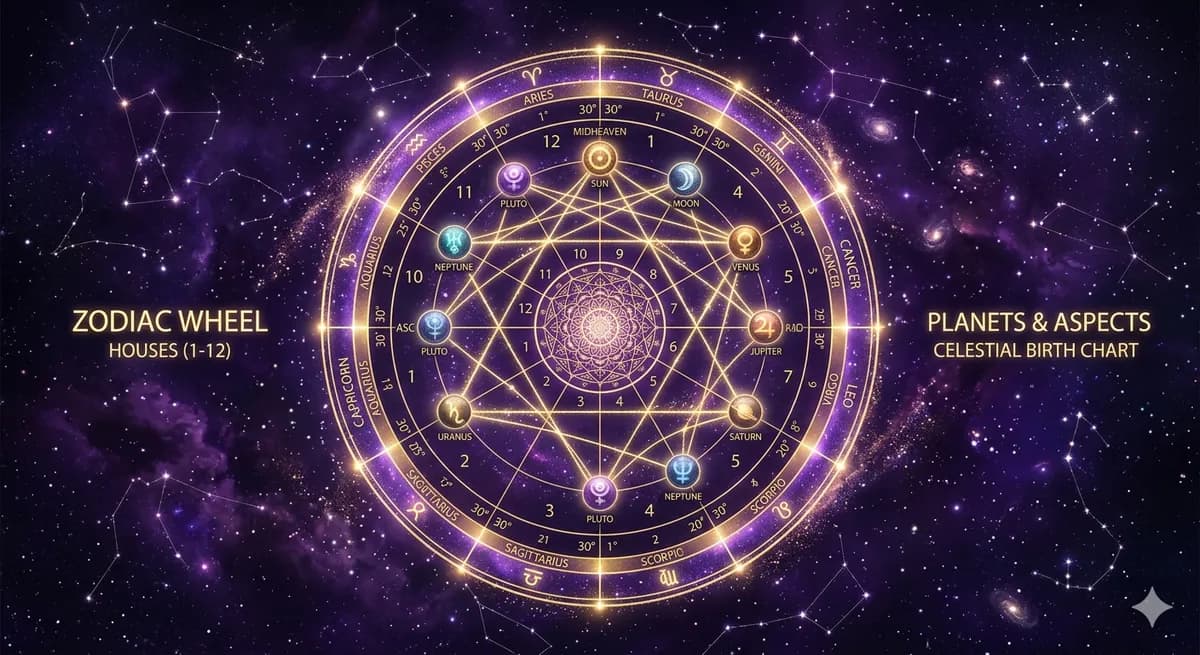
A birth chart--also called a natal chart, astral chart, or natal theme--is a diagram representing the exact positions of celestial bodies (Sun, Moon, planets, asteroids, and mathematical points) at the precise moment of your birth, as seen from the location where you were born.
Visually, it is a circle divided into twelve sections (houses) filled with symbols representing planets and zodiac signs. It can look intimidating at first glance, but each element carries a clear, specific meaning.
Think of it this way: if the planets are actors in a play, the zodiac signs are the costumes they wear, and the houses are the stages where they perform. The aspects--the relationships between planets--are the script that ties the whole story together.
The Four Pillars of a Birth Chart
To read a birth chart, you need to understand its four fundamental building blocks. Let us explore each one in depth.
Pillar 1: The Planets -- The Actors
In astrology, the term "planets" includes the Sun and Moon (technically luminaries) in addition to the solar system's planets. Each one represents a different energy or psychological function.
Personal Planets (Fast Moving)
These planets change signs quickly, making their positions highly personal and specific to your chart.
Sun: Your essential identity, ego, and vitality. It answers the question: "Who am I at my core?" This is what most people know as "their sign" (for example, "I am an Aries").
Moon: Your emotional world, instincts, and deepest needs. It represents how you process emotions and what you need to feel safe. The Moon changes signs roughly every two and a half days, making it far more personal than the Sun.
Mercury: Your mind and communication style. It governs how you think, learn, speak, and process information. If you have ever wondered why two people with the same Sun sign think so differently, Mercury's position is usually the answer.
Venus: Love, beauty, values, and pleasure. It indicates how you love, what you find beautiful, what you value, and how you enjoy life. It is also linked to personal finances and your relationship with money.
Mars: Action, energy, willpower, and desire. It shows how you pursue your goals, handle anger and conflict, and what ignites your passion. It is also associated with physical attraction and sexuality.
Social Planets (Medium Speed)
Jupiter: Expansion, abundance, luck, and wisdom. It indicates where you find opportunities, how you grow, and what fills you with optimism. Jupiter spends roughly one year in each sign.
Saturn: Structure, discipline, limitations, and lessons. It points to where you face challenges that strengthen you, which areas require hard work and patience, and where you develop your greatest maturity. Saturn stays about two and a half years in each sign.
Generational Planets (Slow Moving)
These planets spend years in a single sign, so their effect is more generational than personal. However, their house placement and aspects to other planets remain highly individual.
Uranus: Revolution, innovation, the unexpected. Where Uranus falls in your chart shows where you seek freedom and where you might experience sudden changes.
Neptune: Spirituality, imagination, illusion. It signals where you are most intuitive but also where you might deceive yourself.
Pluto: Deep transformation, power, regeneration. It points to where you experience the most intense crises and the most profound transformations of your life.
Pillar 2: The Zodiac Signs -- The Costumes
The twelve zodiac signs represent archetypal energies. When a planet is placed in a particular sign, it expresses itself through that sign's qualities.
Signs are classified in several ways:
By Element
- Fire (Aries, Leo, Sagittarius): Energy, enthusiasm, inspiration, direct action.
- Earth (Taurus, Virgo, Capricorn): Practicality, stability, materiality, sensory awareness.
- Air (Gemini, Libra, Aquarius): Intellect, communication, ideas, sociability.
- Water (Cancer, Scorpio, Pisces): Emotion, intuition, depth, empathy.
By Modality
- Cardinal (Aries, Cancer, Libra, Capricorn): Initiators, leaders, self-starters.
- Fixed (Taurus, Leo, Scorpio, Aquarius): Persistent, stable, determined.
- Mutable (Gemini, Virgo, Sagittarius, Pisces): Adaptable, flexible, versatile.
When you combine the planet with the sign, you get a very specific description. For example, Venus in Aries loves passionately, directly, and impatiently, while Venus in Capricorn loves seriously, committedly, and cautiously.
Pillar 3: The Houses -- The Stages
The twelve houses represent different life areas or domains. While signs describe how an energy expresses itself, houses indicate where in your life it shows up.
- 1st House (Ascendant): Your identity, physical appearance, and the image you project.
- 2nd House: Money, possessions, personal values, and self-worth.
- 3rd House: Communication, siblings, neighbors, short trips, and early learning.
- 4th House (IC): Home, family, roots, the mother, and your inner world.
- 5th House: Creativity, romance, children, fun, and self-expression.
- 6th House: Health, daily work, routines, service, and pets.
- 7th House (Descendant): Partnerships, marriage, contracts, and open enemies.
- 8th House: Transformation, sexuality, death and rebirth, shared resources, and inheritance.
- 9th House: Philosophy, higher education, long-distance travel, religion, and mental expansion.
- 10th House (Midheaven): Career, public reputation, ambition, and the father.
- 11th House: Friendships, groups, collective projects, hopes, and wishes.
- 12th House: Spirituality, the unconscious, retreat, hidden karma, and self-sabotage.
For example, if you have Mars in the 10th House, your energy and ambition are strongly directed toward your professional career. If Mars were in the 7th House instead, that same energy would express itself through your partnerships.
Pillar 4: The Aspects -- The Script
Aspects are the angular relationships between planets. They are perhaps the most important--and most complex--component of the birth chart because they reveal how the different parts of your personality interact with each other.
Major Aspects
Conjunction (0 degrees): Two planets merge their energies. Can be harmonious or tense depending on which planets are involved. This is the most powerful aspect.
Sextile (60 degrees): A harmonious aspect indicating natural talents and opportunities. Requires a small effort to activate.
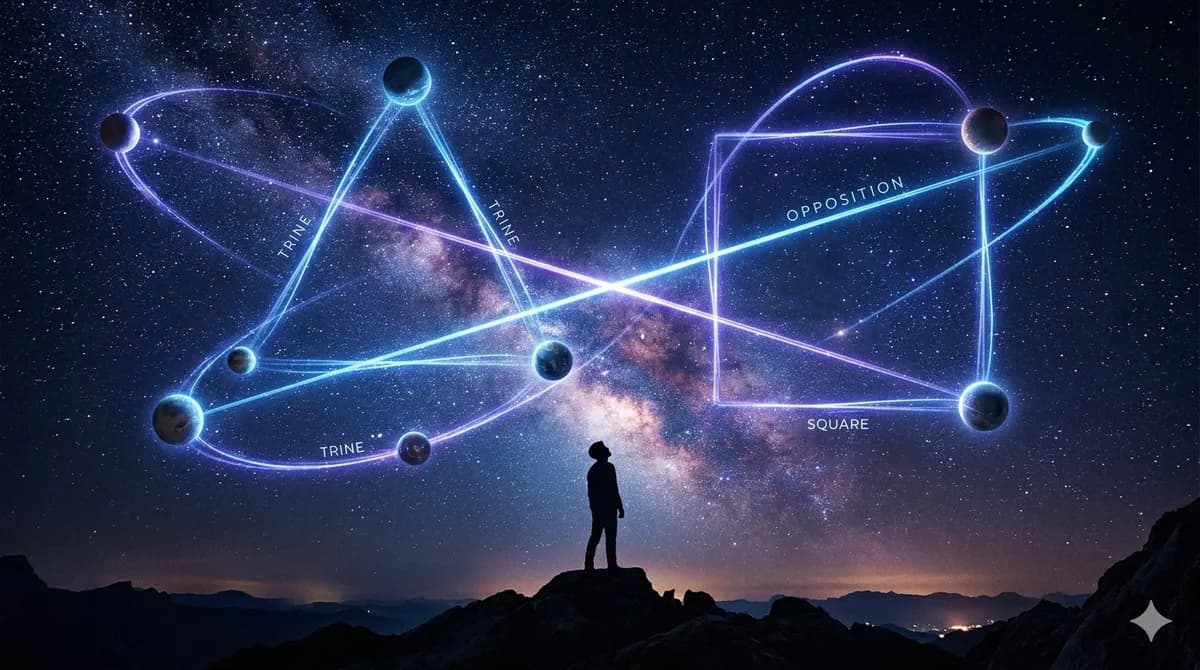
Square (90 degrees): A tense, challenging aspect. It generates internal friction that, when handled well, fuels growth. Squares are the engines of change in a chart.
Trine (120 degrees): An aspect of harmony and flow. It indicates innate talents and areas where things come naturally.
Opposition (180 degrees): An aspect of polarity and projection. Two opposing energies that need to find balance. Often manifests through relationships with other people.
For example, a square between the Moon and Saturn can indicate early emotional difficulties or a complex relationship with one's mother, but it also points to enormous emotional resilience developed through those very challenges.
How to Read Your Birth Chart Step by Step
Now that you understand the building blocks, here is how to read a birth chart systematically.
Step 1: Identify the Big Three
Always start with the fundamental trio:
- Sun: Your Sun sign tells you who you are at your core.
- Moon: Your Moon sign reveals how you feel and what you need emotionally.
- Ascendant: Your rising sign shows how you present yourself to the world.
These three elements alone give you a far more complete picture than simply knowing your Sun sign.
Step 2: Look at the Element Distribution
Count how many planets you have in Fire, Earth, Air, and Water signs. If one element dominates, that energy is prominent in your personality. If an element is missing, that is an area you likely need to develop consciously.
Step 3: Check the Planets in the Houses
See which houses contain your planets. Houses with more planets indicate the life areas where you concentrate the most energy and attention.
Step 4: Analyze the Major Aspects
Look for conjunctions, squares, and oppositions first, as these are the most powerful aspects. Then examine trines and sextiles to identify your natural talents.
Step 5: Look for Patterns
Special configurations--such as a Grand Trine, a T-Square, or a Stellium (three or more planets in the same sign or house)--tell a particular story and serve as focal points in your chart.
Common Mistakes When Interpreting a Birth Chart
Reducing everything to the Sun sign
This is the most common error. Your Sun sign is just one piece of the puzzle. Two Geminis with different Moon, Ascendant, and planetary positions will have very different personalities.
Interpreting tense aspects as "bad"
Squares and oppositions are not malefic. They are dynamic, challenging, and create movement. Many of the most successful people have charts full of tense aspects that propelled them to grow.
Ignoring the houses
Many people focus exclusively on signs and forget about houses. But houses are essential because they contextualize where planetary energies manifest in your actual life.
Taking interpretations literally
Astrology speaks in symbols. "Mars in the 8th House" does not literally mean danger of death. It means an intense energy of transformation, power, and regeneration.
How AI Simplifies Reading Your Birth Chart
With all of the above, it is easy to see why interpreting a birth chart can feel overwhelming for a beginner. This is exactly where artificial intelligence makes a real difference.
Aspectados uses advanced AI to do the heavy lifting for you:
- Automatically calculates all planetary positions with astronomical precision.
- Synthesizes interpretations of planets, signs, houses, and aspects into a coherent, easy-to-understand narrative.
- Prioritizes what matters most in your chart so you do not get lost in secondary details.
- Answers your questions in real time, allowing you to dive deeper into any specific element.
- Explains in plain language, without unnecessary jargon, making astrology accessible to everyone.
Instead of spending hours studying tables and aspect patterns, you can get a complete, personalized interpretation in minutes and then explore each detail at your own pace through the interactive chat.
Frequently Asked Questions About Birth Charts
Do I need to know my birth time?
Ideally, yes. Your birth time determines the Ascendant and house placements, which are key elements. However, even without an exact time, you can still gain valuable information about your planetary sign placements.
Does my birth chart change over time?
No. Your natal chart is fixed because it represents the sky at the moment of your birth. What does change are the transits--the current positions of the planets and how they interact with your natal chart.
Does a birth chart predict the future?
A birth chart is not a deterministic prediction tool. It shows tendencies, potentials, and challenges, but not fixed events. You are the one who decides how to express the energies in your chart.
How accurate is astrology?
Astrology is a symbolic system, not a science in the modern empirical sense. Its value lies in its capacity to offer frameworks for self-knowledge and reflection. Thousands of people find their birth charts strikingly accurate in describing their personality tendencies.
Take the First Step
Now that you understand the fundamentals of the birth chart, it is time to explore your own. You do not need to memorize every meaning at once; understanding deepens with practice and curiosity.
Visit Aspectados to generate your free AI-powered birth chart. Let artificial intelligence guide you through every planet, sign, house, and aspect of your natal map. Ask questions, explore, and discover the cosmic patterns that form the foundation of who you are.
Astrology does not define you. It illuminates you. And your birth chart is the lantern.