Planetary Aspects: Conjunction, Opposition, Trine, Square, and Sextile
Planetary Aspects Explained: Conjunction, Opposition, Trine, Square, and Sextile
Planetary aspects are one of the fundamental pillars of astrology. While zodiac signs tell us about energies and archetypes, and astrological houses define areas of life, aspects reveal how planets communicate with each other in your birth chart. They are the dynamic relationships that bring your astral map to life.
If you have ever wondered why certain areas of your life flow with ease while others generate constant tension, the answer likely lies in your planetary aspects. In this article, we break down each of the major and minor aspects so you can understand your birth chart with greater depth.
What Are Planetary Aspects
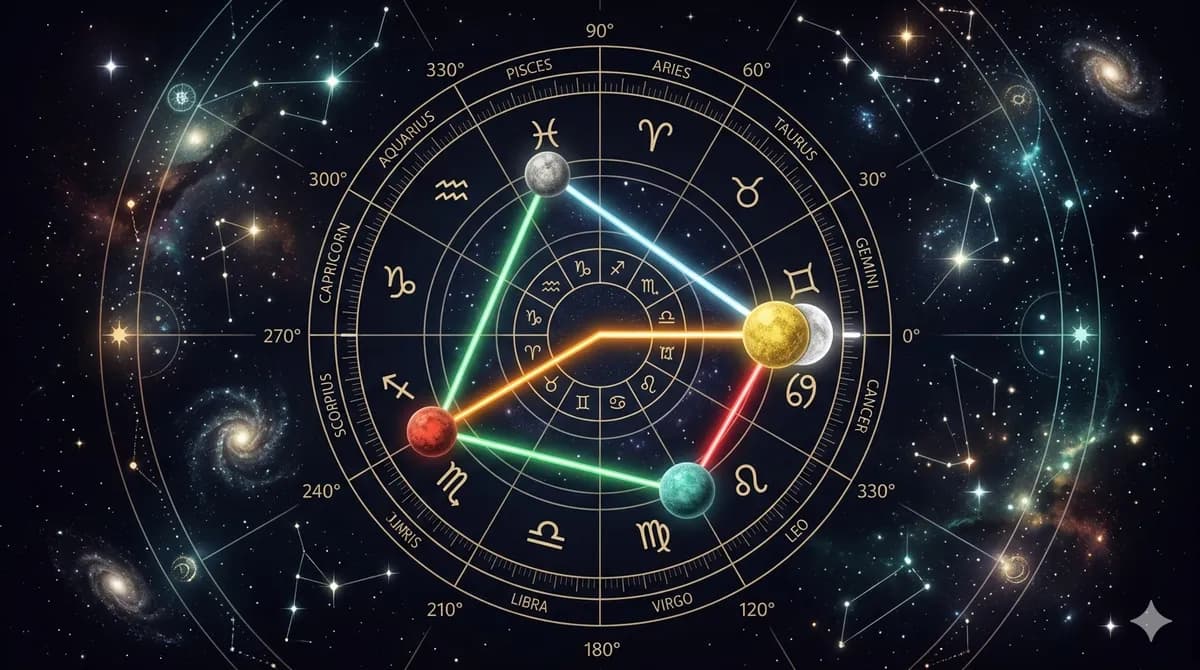
A planetary aspect is the angular relationship between two planets measured in degrees along the ecliptic (the 360-degree circle of the zodiac). When two planets are found at specific angular distances from each other, they are said to be "in aspect," meaning they are interacting energetically.
Imagine the zodiac as a circular clock. If one planet is at 10 degrees of Aries and another at 10 degrees of Leo, they are separated by 120 degrees, forming a trine. This geometric relationship creates a dialogue between the energies of both planets.
Not all angles produce aspects. Traditional astrology recognizes five major aspects and several minor ones, each with a distinct energetic quality.
The Five Major Aspects
Conjunction (0 degrees)
The conjunction occurs when two planets are at the same degree of the zodiac, or very close to it. It is the most potent aspect because the energies of both planets merge into a single force.
Quality: intense, concentrated, powerful. It is not inherently positive or negative; it depends on the planets involved.
How it works: planets in conjunction act as an inseparable team. Venus conjunct Jupiter amplifies love, generosity, and beauty. Mars conjunct Saturn creates tension between impulsive action and restriction. Sun conjunct Neptune merges identity with imagination and spirituality.
In the birth chart: a conjunction indicates an area of intense focus in your life. The qualities of both planets are so intertwined that it can be difficult to separate them. It is a source of great power, but it can also generate blind spots.
Opposition (180 degrees)
The opposition occurs when two planets are in directly opposite signs of the zodiac. It is an aspect of polarity and tension that calls for integration.
Quality: dynamic, challenging, revealing. It creates a seesaw tension where both planets pull in opposite directions.
How it works: oppositions are often experienced through relationships and external situations. Moon opposite Pluto can manifest as emotionally intense relationships. Venus opposite Saturn generates tension between the desire for love and the fear of rejection.
In the birth chart: oppositions show us areas where we need to find balance between two opposing forces. The challenge is to stop oscillating between extremes and learn to integrate both energies. When achieved, the opposition becomes a source of great wisdom and perspective.
Trine (120 degrees)
The trine connects planets in signs of the same element (fire with fire, earth with earth, air with air, water with water). It is the most harmonious and fluid aspect.
Quality: easy, natural, talented. Energy flows effortlessly between the planets.
How it works: planets in trine support each other naturally. Mercury trine Jupiter facilitates communication and learning. Moon trine Venus grants natural charm and emotional well-being. Mars trine Uranus produces innovative and bold energy.
In the birth chart: trines represent innate talents and areas of ease. The danger is complacency: since energy flows so naturally, we may not develop these gifts to their fullest. Trines are gifts that require conscious action to be fully leveraged.
Square (90 degrees)
The square connects planets separated by 90 degrees, usually in signs of the same modality (cardinal, fixed, or mutable) but incompatible elements. It is the aspect of greatest friction.
Quality: tense, motivating, challenging. It generates internal conflict that drives action.
How it works: squares create a clash between energies that do not easily understand each other. Sun square Moon generates tension between conscious will and emotional needs. Venus square Mars produces tension between the desire for harmony and the need for direct action.
In the birth chart: squares are the engines of growth. Although uncomfortable, they are what push us most to evolve. People with many squares tend to have dynamic, achievement-filled lives, precisely because the tension compels them to act.
Sextile (60 degrees)
The sextile connects planets in compatible signs of complementary elements (fire with air, earth with water). It offers opportunities that require minimal effort to activate.
Quality: opportunistic, cooperative, stimulating. Similar to the trine but less automatic.
How it works: sextiles open doors, but you must walk through them. Mercury sextile Mars grants mental sharpness when you make the effort. Moon sextile Saturn provides emotional stability when you actively seek it.
In the birth chart: sextiles represent latent opportunities that activate when you take initiative. They are less flashy than trines, but enormously productive when consciously worked with.
Minor Aspects: Quincunx and Semi-Sextile
Quincunx or Inconjunction (150 degrees)
The quincunx connects signs that share neither element nor modality. It is an aspect of constant adjustment and a certain discomfort.
How it works: planets in quincunx feel like pieces from different puzzles. They require continuous adaptation. Sun quincunx Neptune can manifest as recurring confusion about identity or difficulty integrating practice with ideals.
In the birth chart: it indicates areas where you need to make creative adjustments for two parts of your nature to work together. It never fully resolves, but learning to manage this tension produces extraordinary flexibility.
Semi-Sextile (30 degrees)
The semi-sextile connects adjacent zodiac signs, which have very different energies despite their proximity.
How it works: it is a subtle aspect that generates a mild but constant irritation, like a pebble in your shoe. The key is to pay attention to it, because its lessons are valuable though discreet.
Hard Aspects vs. Soft Aspects
In astrology, aspects are classified into two broad categories:
Soft or harmonious aspects (trine, sextile): facilitate the flow of energy. They represent talents, support, and areas of ease. Their risk is passivity.
Hard or dynamic aspects (square, opposition): generate tension and challenge. They represent areas of growth, conflict, and motivation. Their risk is excessive stress.
The conjunction is considered a neutral aspect whose nature depends on the planets involved.
A balanced birth chart usually has a mix of both types. Charts with many soft aspects may indicate a comfortable life but with less growth impulse. Charts with many hard aspects often belong to resilient, achievement-oriented people.
Applying vs. Separating Aspects
An important technical detail is whether an aspect is applying or separating:
- Applying aspect: the faster planet is approaching the exact aspect. Energy is building and the experience feels like something coming toward you. Applying aspects carry greater force and intensity.
- Separating aspect: the faster planet has already passed the exact point and is moving away. Energy is diminishing and the experience feels like something fading into the past.
In planetary transits, this distinction is especially relevant for determining whether an event is about to happen or is already in the process of resolution.
Orbs: How Exact Must an Aspect Be
The orb is the margin of degrees allowed to consider an aspect active. An exact trine would be precisely 120 degrees, but a trine at 117 or 123 degrees is also considered valid.
Generally accepted orbs are:
- Conjunction and opposition: up to 8-10 degrees
- Trine and square: up to 6-8 degrees
- Sextile: up to 4-6 degrees
- Minor aspects: up to 2-3 degrees
The more exact the aspect, the more intensely it is felt. An aspect with an orb of one degree or less is partile, and its influence is powerful and evident.
The luminaries (Sun and Moon) receive wider orbs due to their importance in the chart. Slow planets like Pluto receive narrower orbs.
How to Identify Important Aspects in Your Chart
Not all aspects carry equal weight. To identify the most relevant ones in your birth chart, pay attention to:
- Aspects to the Sun, Moon, and Ascendant: these are the most personal and influential
- Partile aspects: the most exact are the most potent
- Aspects involving the Ascendant ruler: these have an especially direct impact on your life
- Aspect configurations: such as the Grand Cross, Grand Trine, or T-Square, which combine multiple aspects into significant geometric patterns
At Aspectados, our artificial intelligence automatically identifies the most relevant aspects in your birth chart and explains their meaning in a clear and personalized way.
Aspect Configurations: Powerful Geometric Patterns
When multiple aspects combine, they form special configurations with amplified meaning:
Grand Trine: three planets forming trines with each other, creating an equilateral triangle. It grants exceptional talent in the element involved, but can generate passivity if not consciously worked with.
T-Square: two planets in opposition, both square a third planet (the focal planet). It is one of the most dynamic and productive configurations. The focal planet becomes the discharge point for all the tension.
Grand Cross: four planets forming two oppositions and four squares. It generates enormous internal tension, but also an extraordinary capacity for achievement when one learns to channel the energy.
Yod (Finger of God): two planets in sextile, both quincunx a third planet. It signals a special purpose or mission that requires constant adjustments to fulfill.
Kite: a Grand Trine with an additional planet forming an opposition with one of the vertices. It combines the talent of the Grand Trine with the motivation of the opposition.
Understanding Your Aspects to Know Yourself Better
Planetary aspects are the secret language of your birth chart. They reveal the internal dynamics that drive your decisions, relationships, and life patterns. Understanding your trines shows you where you shine effortlessly. Understanding your squares reveals where your greatest growth potential lies.
If you want to explore your birth chart aspects in detail, visit Aspectados and let our astrological AI guide you through the fascinating geometric connections that make your astral map a unique and unrepeatable document.