Personal, Social, and Transpersonal Planets: The Complete Map of Your Birth Chart
When you look at your birth chart for the first time, every planet seems to carry the same weight. But astrologers know there is a quiet hierarchy at work: some planets speak to your intimate personality, others to your place in society, and others to the collective soul of your entire generation. Learning to tell them apart is one of the most important steps toward reading a chart with real depth. At Aspectados you can see all of these planets placed in your chart and understand, in plain language, exactly which part of you each one represents.
This classification rests on something wonderfully simple: speed. The faster a planet moves through the zodiac, the more personal and unique its influence. The slower it travels, the more that energy is shared with millions of people born around the same time as you. Let's walk through the three groups.
A sky divided into three speeds
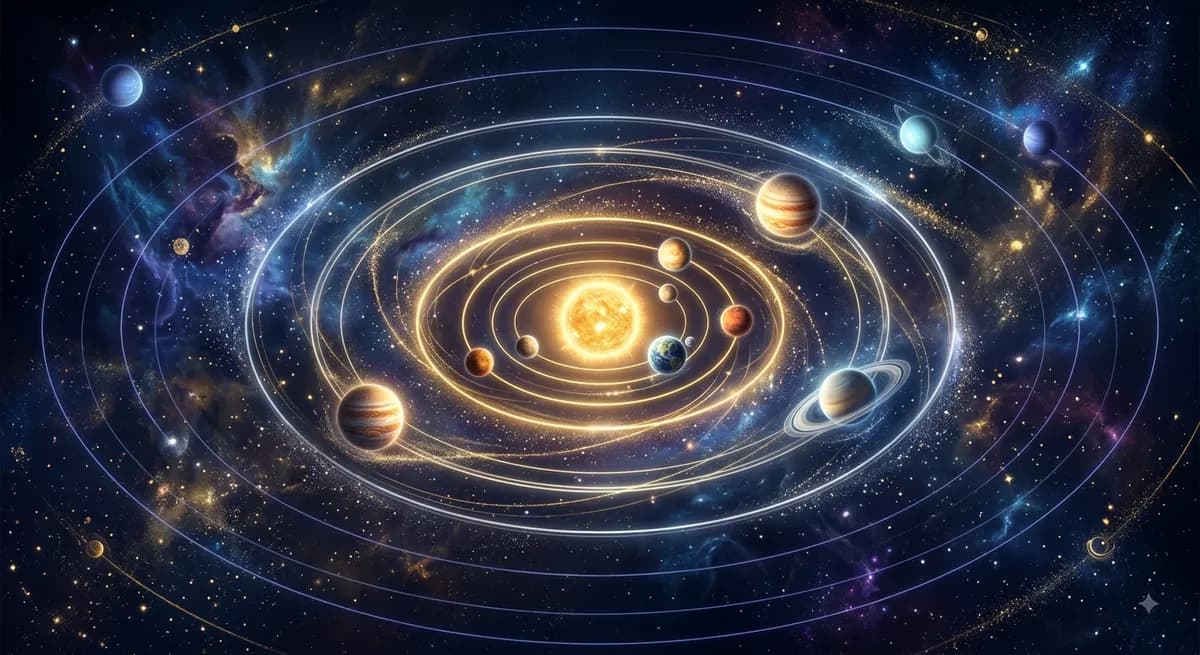
Planets are grouped by their orbital rhythm into personal planets, social planets, and transpersonal planets (also called generational planets). The Sun takes about a month to cross a sign; Pluto can spend twenty years in the same one. That difference changes everything about how you interpret them.
The personal planets: Sun, Moon, Mercury, Venus, and Mars
The personal planets move quickly and describe your individual character. They are the ones you genuinely experience as "you." Two people born a single day apart can have the Moon, Mercury, or Venus in different signs, and that makes each of them unique.
The Sun
The Sun represents your essential identity, your will, and what you have come here to develop in this life. It is your underlying purpose, the light you want to radiate. When someone asks "what's your sign?", the answer is their Sun.
The Moon
The Moon governs your emotional world, your instinctive needs, and what makes you feel safe. It is your inner landscape, your memory and your capacity to nurture. It changes signs every two and a half days, so it is deeply personal.
Mercury
Mercury rules the mind: how you think, learn, speak, and process information. It never strays far from the Sun, and its sign reveals your communication style and your way of reasoning.
Venus
Venus speaks of love, pleasure, aesthetics, and values. It shows what attracts you, how you bond emotionally, and what you find beautiful or worthwhile. It is essential in any reading about relationships.
Mars
Mars is energy, desire, assertiveness, and the way you act and fight for what you want. Its sign describes how you pursue your goals and how you channel anger or passion.
The social planets: Jupiter and Saturn
Between the intimate and the collective sit the social planets. Jupiter and Saturn act as a bridge: they describe how you relate to the structures of society, to growth, to rules, and to your place in the world. They move more slowly, so they share a sign with everyone born within a one- or two-year window.
Jupiter
Jupiter is expansion, abundance, faith, and a sense of meaning. It takes about twelve years to circle the zodiac (roughly a year per sign). It shows where you seek to grow, where you tend to be lucky, and how you approach philosophy, travel, and higher learning.
Saturn
Saturn represents structure, responsibility, limits, and the mastery that is earned through effort. It spends about two and a half years in each sign. It marks where you must mature, apply discipline, and build something solid and lasting. Its lessons are demanding, but they forge character.
The transpersonal or generational planets: Uranus, Neptune, and Pluto
The transpersonal planets move so slowly that they define entire generations. Uranus spends about seven years in each sign, Neptune around fourteen, and Pluto anywhere from twelve to thirty. That is why their sign placement says more about your era than about you as an individual.
Uranus
Uranus is freedom, rebellion, innovation, and sudden breakthroughs. It represents where your generation breaks the mold and reaches for change and originality.
Neptune
Neptune rules spirituality, dreams, art, and compassion, but also illusion and confusion. It describes the ideals and the collective fog of your era.
Pluto
Pluto is deep transformation, power, death, and rebirth. It marks the great processes of regeneration that each generation lives through.
Why this distinction changes everything
Here is the key that many beginners miss: the outer planets only become truly personal when they touch your chart directly.
If your Pluto is in Scorpio simply because you were born in a certain era, you share that placement with millions of people, and it says little about your individuality. But if that same Pluto is conjunct your Ascendant, in a tight aspect to your Sun or Moon, or sitting right on one of the chart's angles (Ascendant, Descendant, Midheaven, or Imum Coeli), then that generational energy pours into your personal life with tremendous intensity.
In other words:
- Personal planets are "you" almost all the time.
- Social planets describe your relationship to the world and its rules.
- Transpersonal planets are generational... unless they aspect a personal planet or an angle, at which point they become profoundly yours.
How to work with this hierarchy when reading your chart
When you interpret a chart, follow this order so you don't get lost:
- Start with the fundamental trio: Sun, Moon, and Ascendant. They give you about 70% of the portrait of the person.
- Add the remaining personal planets: Mercury, Venus, and Mars refine the mind, love, and action.
- Bring in Jupiter and Saturn: they reveal how that person grows and where they take on responsibility in society.
- Read the transpersonals by house and by aspect, not by sign: ask which area of life (house) they operate in, and whether they touch a personal planet. That is where their true individual relevance lies.
A great exercise is to ask yourself: "Does this planet describe something unique about me, or something I share with my whole generation?" That single question will spare you many interpretation errors and keep you from giving Neptune or Pluto disproportionate weight based on sign alone.
Conclusion
Understanding the difference between personal, social, and transpersonal planets completely transforms how you read a birth chart. You will no longer see ten scattered planets, but three ordered layers: your individual core, your bridge to society, and the tide of your generation. It is the difference between memorizing and genuinely understanding.
If you'd like to see this structure come alive in your own chart, discovering which planets define you as an individual and which ones speak of your times, create your birth chart at Aspectados and let its artificial intelligence guide you with a clear, warm, and personalized interpretation of every planet and every layer of your celestial map.