Ophiuchus, the "13th Sign": Myth, Reality and Why Your Sign Hasn't Changed
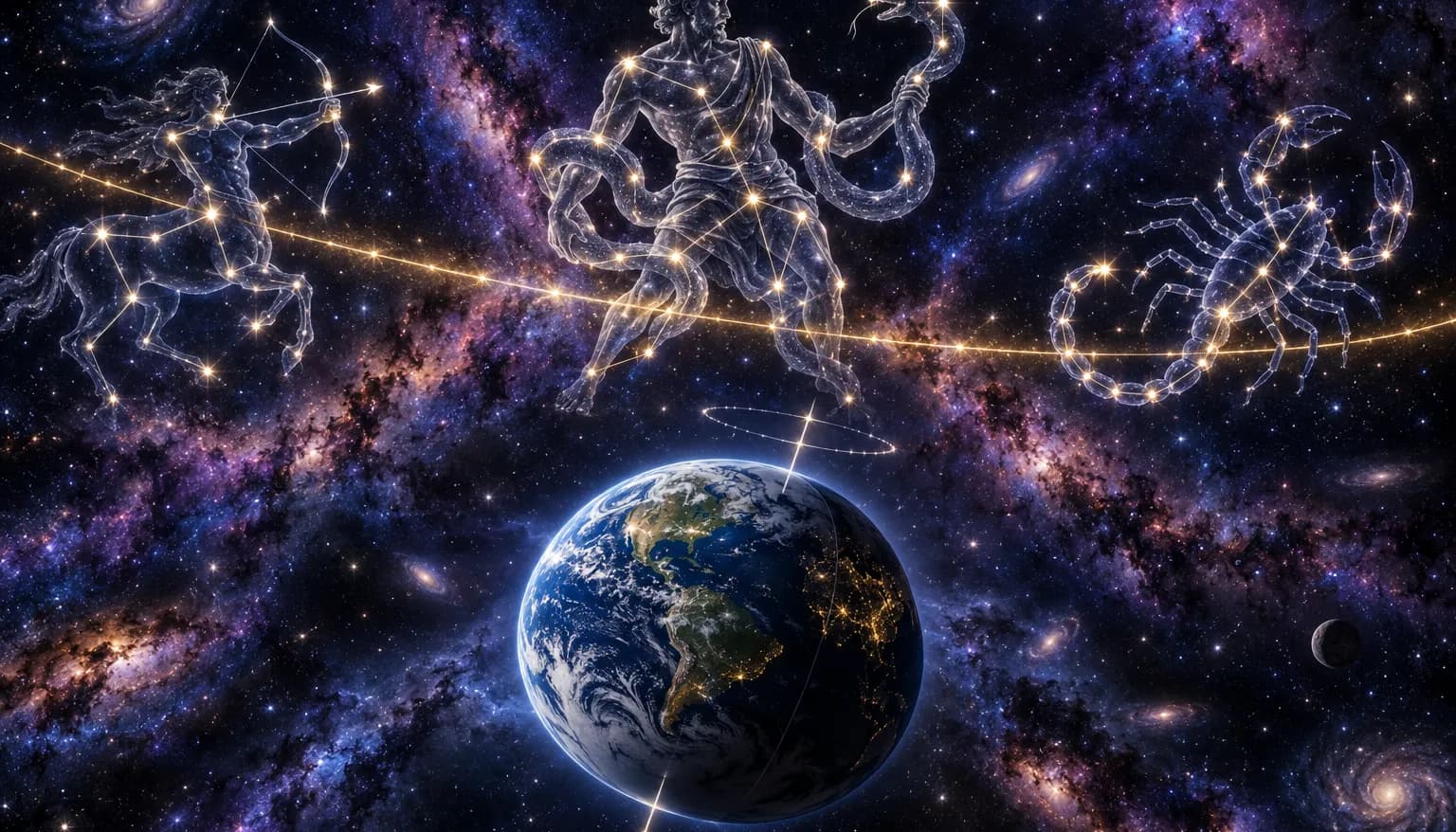
Every so often the same alarming headline sweeps across social media: "there is a 13th zodiac sign and your sign has changed." The star of the story is Ophiuchus, a real constellation that the Sun passes through every year. But does that mean you're no longer a Scorpio or a Sagittarius? The short answer is no. At Aspectados we explain what Ophiuchus is, the difference between signs and constellations, and why Western astrology still uses twelve signs.
What Ophiuchus Represents in Astronomy and Mythology
Ophiuchus (Latin for "the serpent bearer") is one of the 88 constellations recognized by the International Astronomical Union. Its symbolism includes:
- The healer: in Greek mythology it is usually identified with Asclepius, god of medicine, who was said to be able to bring even the dead back to life.
- The serpent: Ophiuchus holds the constellation Serpens, the Serpent, a symbol of renewal and healing that still appears on medical emblems today.
- Forbidden knowledge: according to the myth, Zeus punished Asclepius for crossing the boundary between life and death.
- A giant figure: it is a large, fairly faint constellation located between Scorpius and Sagittarius in the sky.
Myth and Reality: The Key Points of the Debate
Constellations and signs are not the same thing
This is the heart of the whole confusion. Constellations are groupings of stars of very different sizes: some cover a lot of sky, others very little. Zodiac signs, on the other hand, are twelve equal 30° segments dividing the ecliptic, the Sun's apparent path. The signs took their names from the constellations more than two thousand years ago, but they are a system of measurement, not a star map.
Yes, the Sun passes through Ophiuchus
Astronomically, it's true: the ecliptic crosses the constellation Ophiuchus, and the Sun travels through it roughly from November 29 to December 17. This was already known in antiquity. The Babylonian and Greek astronomers who established the zodiac deliberately chose twelve equal divisions, linked to the roughly twelve lunar months in a year, and left Ophiuchus out.
The tropical zodiac is tied to the seasons
Western astrology uses the tropical zodiac, which is based not on the stars but on the seasons. Aries always begins at the March equinox, Cancer at the June solstice, Libra at the September equinox and Capricorn at the December solstice. That's why your Sun sign doesn't change: it depends on the Sun's position relative to the equinoxes, not on the constellations in the background.
The precession of the equinoxes
Because of a slow wobble in the Earth's axis, the equinox point shifts against the stars by roughly one degree every 72 years. As a result, the start of tropical Aries today no longer lines up with the constellation Aries but with Pisces. This phenomenon, called the precession of the equinoxes, has been known since Hipparchus in the 2nd century BCE, and astrologers have accounted for it for centuries.
The sidereal zodiac
Some traditions, such as Vedic astrology (Jyotish), use the sidereal zodiac, which is aligned with the stars through a correction called the ayanamsa. Even so, the sidereal zodiac also uses twelve equal signs and does not include Ophiuchus. There is a difference of about 24° between the two zodiacs, so many people have a sidereal sign that differs from their tropical one, but that has nothing to do with a "13th sign."
What NASA actually said
In 2016, the idea that NASA had "changed the zodiac signs" went viral. In reality, it was an educational page for students explaining the difference between constellations and signs, which mentioned that the Sun passes through Ophiuchus. It did not propose any change to astrology, which is not NASA's field. The agency later stressed that it had not changed any signs and had only explained the astronomy.
The 13-sign zodiac
There are modern proposals for a zodiac of 13 constellations with unequal lengths, which some people use playfully or experimentally. It is a minority option and is not part of either the Western or the Vedic astrological tradition.
Why the myth keeps coming back
The "13th sign" resurfaces periodically because it mixes a true astronomical fact (the Sun crosses Ophiuchus) with a mistaken conclusion (that your sign depends on the constellations). On top of that, the idea of having "been the wrong sign your whole life" is irresistible and spreads easily. Once you understand that Western astrology measures the sky from the seasons rather than from star patterns, the hoax falls apart in seconds.
How to Respond the Next Time It Goes Viral
- Remember the difference: signs ≠ constellations. Signs measure time and the seasons; constellations are star figures.
- Your sign depends on the system: in the tropical zodiac, the one used in Western astrology, your Sun sign remains the same.
- Precession isn't news: astrologers have known about it for more than two millennia.
- Explore the sidereal zodiac if you're curious: comparing your tropical and sidereal charts can be enriching, as long as you know which system you're using.
- Enjoy the myth: Ophiuchus's symbolism as a healer can be inspiring, even if it isn't a sign in your chart.
Does Ophiuchus Have Any Use in Astrology?
Some astrologers consider the fixed stars of the Ophiuchus constellation, such as Rasalhague, in specific interpretations, just as other stars like Regulus or Antares are studied. Others read the themes of healing and knowledge associated with the serpent symbolically when planets fall in the last degrees of Scorpio or the first degrees of Sagittarius. But these are complementary nuances, not a 13th sign.
Conclusion
Ophiuchus is a fascinating constellation with a beautiful myth, but it hasn't changed your sign. Western astrology uses the tropical zodiac, tied to the equinoxes and the seasons, which is why Scorpio is still Scorpio and Sagittarius is still Sagittarius. If you want to explore your full birth chart, with all your planets and the system used to calculate them, visit Aspectados and ask its astrology AI any question about zodiacs, signs and constellations.