Jones Patterns: What the Shape of Your Birth Chart Reveals (Bowl, Bucket, Locomotive and More)
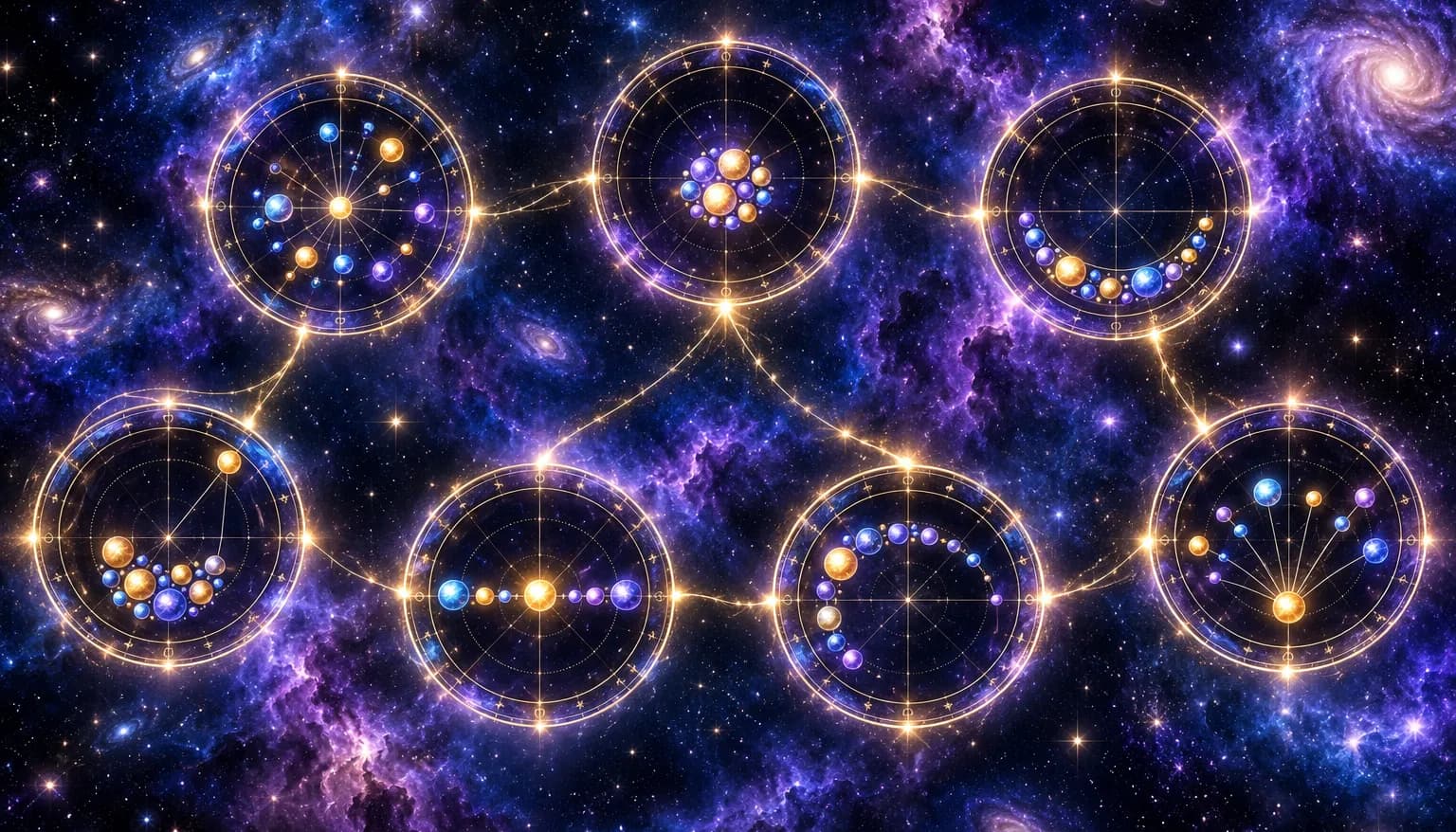
Before reading signs, houses and aspects, there is something you can see at a single glance: the shape of the birth chart. Are the planets spread around the whole wheel or crowded into one area? Is there a lone planet on the other side? In the mid-20th century, American astrologer Marc Edmund Jones turned this first impression into a method. At Aspectados we explain the seven Jones patterns and how to recognize yours.
What Chart Shape Represents in Astrology
In his book Guide to Horoscope Interpretation (1941), Jones proposed classifying charts by how the ten planets are distributed around the zodiac. His idea was that the overall shape describes temperament or life style before you get into the details. The approach includes:
- The big picture: the chart is read as an image before it is read as a list of positions.
- Distribution of interest: where energy concentrates and where there are gaps.
- Highlighted planets: the planet that leads a group or stands alone gains prominence.
- Style of life, not destiny: the patterns describe how we move through life, not what will happen to us.
To identify your pattern, astrologers usually use the ten planets, from the Sun to Pluto, leaving out the angles and points such as the Node or Lilith.
The 7 Jones Patterns
Splash
The planets are spread fairly evenly around the whole wheel, occupying many signs without large gaps. Jones associated it with people of universal interests, able to take on many subjects and adapt to very different settings. Its challenge is scattering: such a wide range can make focus difficult. Well channeled, it gives a broad mind and an almost encyclopedic curiosity.
Bundle
All the planets are packed into one third of the chart, about 120 degrees or less. It is the most concentrated pattern: the person channels their energy into a limited area of life, with great intensity and specialization. They may become an expert in their field, though they can find it hard to understand other perspectives. The planet leading the group in the clockwise direction often sets the tone.
Bowl
The planets occupy half of the chart, about 180 degrees, leaving the other half empty. Jones linked it to a sense of mission or of having something to offer: the person is self-contained and looks toward what is missing. The planet that opens the rim of the bowl is especially significant. Orientation matters too: a bowl in the upper hemisphere is often associated with a more public life, and one in the lower hemisphere with a more private one.
Bucket
This is a bowl with a handle: nine planets in one half and a single planet alone in the opposite half. That isolated planet becomes the chart's focal point, the channel through which all the energy flows. For example, a bucket with Saturn as the handle suggests that responsibility or structure drives the life; if the handle is Venus, love or art. It is one of the easiest patterns to interpret.
Seesaw
The planets form two groups facing each other across the wheel, separated by two empty spaces. Jones associated it with an awareness of opposites: the person tends to weigh alternatives, see both sides of every question and swing between poles. Its challenge is indecision, but it also offers a great capacity for mediation and perspective. The oppositions between the groups often describe life's key tensions.
Locomotive
The planets occupy about two thirds of the chart, around 240 degrees, leaving a one-third gap. Jones linked it to a driving force: energy, self-reliance and determination to move forward. The planet that "pulls the train," the first one to appear after the gap in the clockwise direction, acts as the engine of the personality. It is a pattern associated with practical effectiveness.
Splay
The planets cluster in several irregular groups, often with a stellium, without a clear order. Jones connected it with strong individuality: people who resist being categorized and follow their own interests. They have well-defined centers of energy in several areas at once. They may seem unpredictable, but they have strong inner coherence.
Orientation and the Leading Planet
Shape is not the only thing that matters: where the pattern sits on the wheel counts as well. Astrologers usually look at the hemispheres. A concentration of planets in the upper hemisphere (houses 7 to 12) is associated with a life oriented toward the outside world and public projection; in the lower hemisphere (houses 1 to 6), with the personal and private sphere. If the weight falls in the eastern half (around the Ascendant), it is linked to self-determination; if it falls in the western half (around the Descendant), to collaboration and responsiveness to others.
Jones also emphasized the leading planet: the one at the front of the planetary distribution, following the chart's daily motion. In his approach, that planet shows how the person takes the initiative. Combining shape, orientation and leading planet gives a surprisingly precise portrait before you have analyzed a single aspect. It is a useful exercise for beginners, too, because it trains the eye to see the chart as a whole instead of a collection of isolated pieces.
How to Identify Your Pattern
- Draw or look at your chart: focus only on the ten planets, without angles or points.
- Find the largest gap: measuring the biggest empty space helps you tell a bundle, a bowl and a locomotive apart.
- Spot isolated planets: a single planet alone in the opposite hemisphere usually indicates a bucket.
- Don't force the classification: many charts are hybrids. Jones gave approximate ranges, and some charts fit two patterns.
- Focus on the key planet: the bucket's handle, the bowl's rim or the planet pulling the locomotive are usually very rich interpretive points.
- Combine it with everything else: the pattern is a first layer; signs, houses and aspects provide the detail.
Conclusion
Jones patterns are among the simplest and most visual tools in astrology: one glance at the shape of your chart can tell you whether your energy concentrates, scatters, balances or launches toward a goal. Bowl, bucket, locomotive or splash, each shape tells a story about how you live. If you want to discover the pattern of your birth chart and which planet takes center stage, calculate your chart at Aspectados and ask our astrology AI to interpret its shape.