Fixed Stars in the Birth Chart: Regulus, Algol, Spica, and Their Ancestral Power
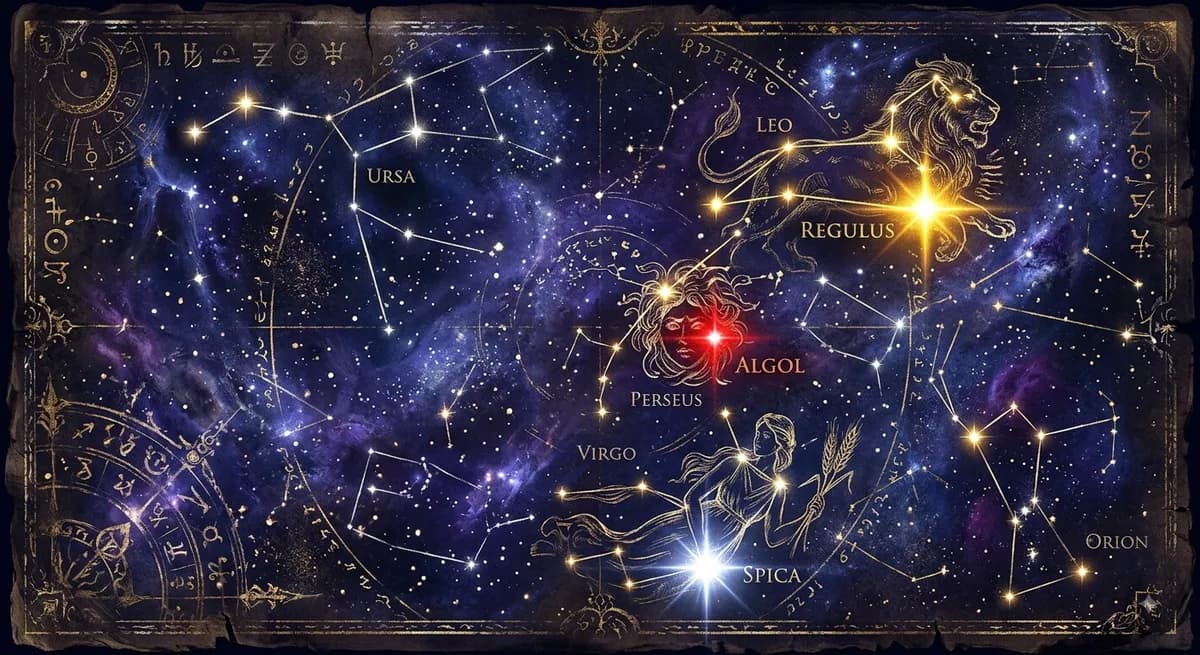
Fixed Stars in the Birth Chart: Regulus, Algol, Spica, and Their Ancestral Power
Before modern horoscopes existed, the astrologers of antiquity looked to the deep sky: the fixed stars. These distant lights were seen as sources of intense, concentrated destiny, capable of raising up or bringing down whoever had them active in their chart. Although today we work mostly with planets, the fixed stars add an ancestral and powerful dimension to the natal reading. At Aspectados, our AI identifies which fixed stars touch your planets and angles to reveal that hidden layer of your chart.
What Fixed Stars Are
The fixed stars are the distant suns that form the constellations. They are called "fixed" because, unlike the planets (the "wandering" stars), they barely change position relative to one another over a human lifetime. They drift very slowly along the ecliptic — about 50 arcseconds per year, due to the precession of the equinoxes — so their current zodiacal position is the fruit of millennia of drift.
The key difference from the planets is their nature: a planet modulates an energy over time; a fixed star acts as a point of destiny, concentrated and intense, almost like a flash. They don't describe processes, but marked qualities, extraordinary gifts, or specific risks.
How Fixed Stars Are Used
Fixed stars are interpreted when they form a conjunction with a planet, with the Ascendant, the Midheaven, or another angle. The golden rule is a very tight orb: usually 1° or less (some schools allow up to 1°30' for the brightest ones). Beyond that margin, the star doesn't count.
The star "colors" the planet or angle it touches. Stars aren't read in isolation, but as a nuance that intensifies and gives archetypal character to what that planet already indicates. The brighter the star (greater magnitude), the more powerful its influence is considered to be.
The Most Famous Fixed Stars
Regulus (~0° Virgo)
Regulus is the "heart of the Lion" (constellation Leo) and one of the four Royal Stars of Persia. Located today around 0° Virgo, it symbolizes royalty, success, leadership, and glory. It grants ambition, honors, and the ability to stand out. But it carries a classic warning: its success can collapse if the person seeks revenge or abuses power. Regulus's downfall usually comes through a lack of nobility. Its lesson: triumph, but keep your integrity.
Algol (~26° Taurus)
Algol, in the constellation Perseus, is the most feared star of the tradition. It represents the head of Medusa and is considered the most intense and "demonic" in the sky. Located near 26° Taurus, it is associated with rage, overflowing passion, extreme intensity, and transformation. Far from being purely negative, Algol grants enormous power: whoever channels it can achieve exceptional strength and magnetism. Poorly handled, it speaks of fury, loss, or crisis. It's the star of kundalini energy, of the primal feminine power that demands respect.
Spica (~24° Libra)
Spica is the ear of wheat held by the Virgin, the brightest star in the constellation Virgo. Located toward 24° Libra, it is one of the most benefic stars in the sky. It grants brilliance, gifts, talent, protection, and good fortune. It is associated with the arts, the sciences, and a kind of grace that protects the person from harm. Where Spica touches, a gift flourishes almost as a blessing.
Other Notable Stars
- Aldebaran (~9-10° Gemini): the "eye of the Bull," another Royal Star. It gives integrity, success, and honor, with the same ethical condition as Regulus: triumph is kept only through honesty.
- Antares (~9-10° Sagittarius): the "heart of the Scorpion," the Royal Star opposite Aldebaran. Intense and warlike, it grants courage, passion, and fighting spirit, but also obsession and a tendency toward self-destruction.
- Sirius (~14° Cancer): the brightest star in the night sky. A symbol of ardor, fame, success, and sacredness; raised to divine status by the ancient Egyptians.
- Fomalhaut (~3-4° Pisces): another Royal Star, tied to the mystical, the idealistic, and the spiritual. It gives inspiration and magic, with the challenge of not getting lost in illusion.
How to Work with Fixed Stars
Check for exact conjunctions. Look for planets or angles within 1° or less of a fixed star. Without a tight conjunction, there's no relevant influence.
Prioritize the bright stars. Regulus, Algol, Spica, Sirius, Aldebaran, Antares, and Fomalhaut are the most powerful. Start with them.
Interpret the star as a color, not an engine. Spica on Venus intensifies artistic talent; Algol on Mars amplifies a force that must be channeled wisely.
Mind the ethics. Many royal stars (Regulus, Aldebaran) promise success conditioned on integrity. Their bright or shadowy side depends on how you live their energy.
A Practical Example
Imagine someone with the Sun at 0° Virgo, in exact conjunction with Regulus. This native carries a mark of success and leadership: they may reach notable positions of power and recognition. But the star whispers its ancient condition: keep your nobility, don't seek revenge, don't abuse your position. If they honor that lesson, Regulus keeps them at the summit; if not, the fall is part of the script.
Another common case: Venus in conjunction with Spica. Here the most benefic star in the sky embraces the planet of love and art, granting a natural aesthetic talent, charm, and a special luck in relationships and creation. It's a blessing that unfolds almost effortlessly, as long as the person dares to cultivate their gift. As you can see, the same technique — a tight conjunction — can speak of conditional glory, untamable force, or protective grace, depending on which star and which planet meet.
It's also worth remembering that fixed stars work quietly. Unlike a bold planetary transit, a fixed-star contact rarely announces itself; it operates like a background theme that colors an entire life. That's why it often goes unnoticed until someone points it out — and why identifying it can feel like discovering a hidden chapter of your own story.
Conclusion
Fixed stars are astrology's oldest memory: points of intense destiny that add drama, gifts, and warnings to your birth chart. They don't replace the planets, but when they touch one precisely, they illuminate an archetypal layer no other technique reveals. At Aspectados, our artificial intelligence automatically detects conjunctions with the most important fixed stars and explains their meaning clearly. Discover which ancestral lights shine in your chart and how to work with their power at Aspectados.