Cazimi and Combustion: What Happens When a Planet Is Too Close to the Sun
Cazimi and Combustion: What Happens When a Planet Is Too Close to the Sun
There is a technical detail that traditional astrology watched very closely, and that is capturing attention again among readers who want more depth in a chart: the distance between a planet and the Sun. Very close to the Sun, a planet can end up burned and hidden or, within a tiny margin, reach its most glorious moment. At Aspectados we explain what cazimi, combustion, and being under the beams mean, and how to interpret them without drama.
What Closeness to the Sun Represents in Astrology
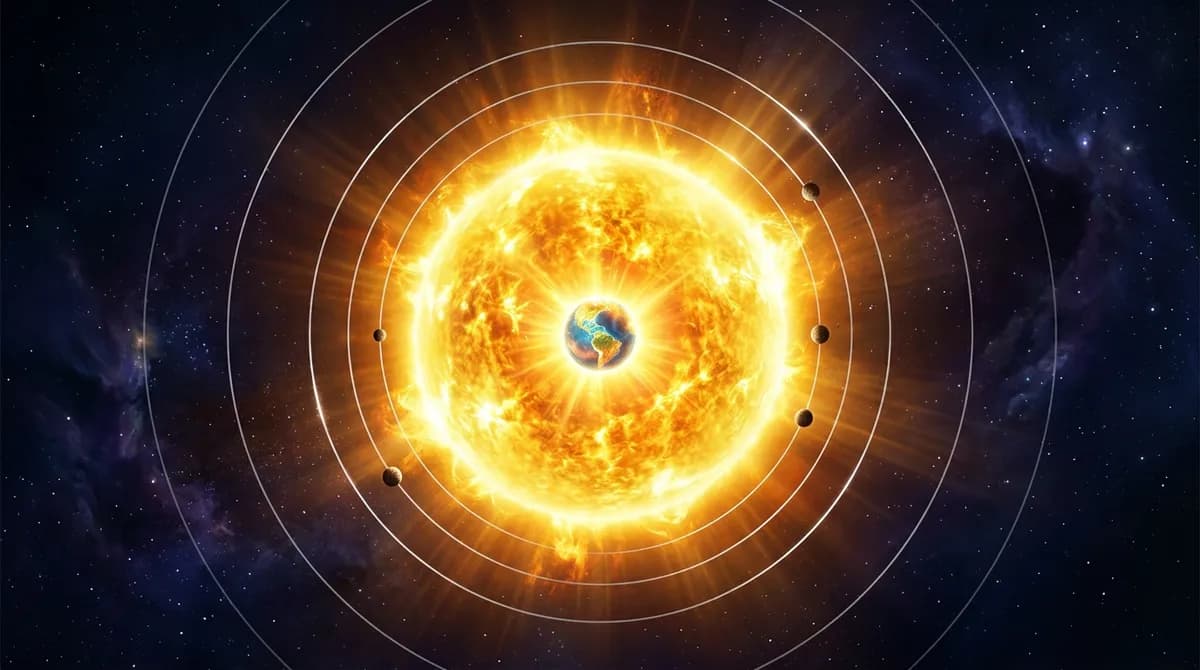
The Sun symbolizes identity, vitality, and the light of consciousness. Its proximity affects the other planets in a very visual way: just as the stars vanish during the day, a planet too near the Sun stops being visible in the sky. Hence the symbolism tradition assigns to it:
- Visibility: a visible planet can "act"; an invisible one works in secret.
- Fusion with identity: its function blends into the solar self.
- Loss of autonomy: it becomes hard to tell what the planet wants from what the ego wants.
- Intensity: the energy does not disappear, it concentrates.
- A luminous exception: in the exact heart of the Sun, tradition sees an enormous gift.
The Three Classical Conditions
Cazimi
The word cazimi comes from Arabic and means something like "in the heart of the Sun". It happens when a planet sits within roughly 17 minutes of arc (0°17') of the Sun, a minuscule distance: remember that one degree contains 60 minutes. Tradition considers such a planet extraordinarily strengthened, like an adviser whispering directly into the king's ear. Because the window is so narrow, a cazimi lasts only a few hours, which makes it a highly sought-after moment.
Combustion
A planet is combust when it lies within about 8°30' of the Sun, although some authors simply use 8°. Here the symbolism flips completely: the planet is described as weakened, hidden, or overpowered by the solar light. Tradition associates it with functions that are hard to express outwardly, matters that stay concealed, or energy that is consumed in the very act of shining.
Under the Beams
The mildest condition is called being under the beams, and it reaches out to roughly 15° from the Sun, with some authors extending the limit to 17°. The planet is dazzled but not scorched: it is considered slightly weakened, somewhat veiled or less objective. Many astrologers read it as a transition zone between full visibility and combustion.
Planet by Planet
Mercury
Along with Venus, this is the planet most often found combust, because it never strays far from the Sun: its maximum elongation is around 28°. That means Mercury spends a good share of its time under the beams. Tradition associates this with a mind closely identified with one's own identity, brilliant but short on detachment. A cazimi Mercury, by contrast, is read as exceptional lucidity with words and ideas.
Venus
Venus can separate from the Sun by up to roughly 47°, so it too is combust fairly often. The classical reading speaks of discreet affections, love lived inwardly, or an aesthetic sense tightly bound to personal identity. In cazimi, Venus is read as a privileged moment for art, beauty, and gestures of love.
Mars
When Mars is combust, tradition describes energy that burns inwardly: impulses that are hard to channel, anger that finds no outlet, or a will thoroughly fused with the ego. On the positive side, it often points to courage spent on inner battles before it is ever shown to the world.
Jupiter
A combust Jupiter is associated with faith and generosity lived privately, with little social recognition. The expansion is real, but it cannot be seen from outside. In cazimi, traditional authors speak of a direct blessing: meaning, confidence, and sound judgement at exactly the right moment.
Saturn
Saturn's combustion is read as limits and responsibilities that stay out of sight: you carry structures, fears, or duties that nobody else notices. As a slow, cold planet, its meeting with the Sun is interpreted as a quiet but profound test of maturity.
The Moon deserves a separate mention: it is combust around every New Moon, when it disappears from the sky to be reborn days later. It is the most everyday reminder that being hidden does not mean being dead, but being in gestation.
In the Birth Chart, in Transits, and in Electional Astrology
In the birth chart, combustion describes a nuance of character, not a sentence. Authors from the tradition such as Guido Bonatti and William Lilly worked with these conditions, and today's traditional astrologers still apply them, especially in horary astrology, where a combust planet may point to something concealed or a matter that is not yet ripe.
In transits and electional astrology the approach is different: here the cazimi is actively hunted. Someone launching a communication venture may wait for a cazimi Mercury; someone thinking of love, art, or a reconciliation may look for a cazimi Venus. These are extremely brief windows, so the timing has to be calculated carefully.
How to Check It in Your Own Chart
It is simpler than it sounds:
- Note the position of the Sun in your chart, in degrees and minutes.
- Note the position of the planet you want to examine.
- Work out the difference between the two (remember that 1° equals 60').
If the difference is 0°17' or less, the planet is cazimi. Out to about 8°30', it is combust. Out to roughly 15°, it is under the beams. Beyond that, it is considered free of the solar influence.
Interpretation Tips
- Don't read it as a verdict. A combust planet still works; it simply acts more inwardly and less visibly.
- Look at the rest of the chart. The house, the aspects, and the planet's dignity greatly qualify the result.
- Reclaim what is hidden. If you have a combust planet, giving it conscious expression helps: name that energy, practise it, and don't leave it permanently in the shade.
- Make use of cazimi moments. They are precious windows for symbolic acts and meaningful beginnings.
- Add the modern view. Contemporary psychological astrology tends to read planets conjunct the Sun as functions strongly identified with the self: rather than "weakened", it sees them as central to the identity, though with little critical distance.
Conclusion
Cazimi and combustion remind us that in astrology it is not only the sign or the aspect that matters, but also the light: how visible a planet is and how far it merges with our identity. Understanding these conditions adds very fine nuances to a chart and explains why some energies are lived inwardly. If you want to know whether any planet in your chart is combust or cazimi, and what that means for you, explore your chart at Aspectados, the AI-powered astrology platform that interprets your birth chart and your transits. Sometimes what cannot be seen is exactly what defines us most.