Vocational Astrology: How Your Birth Chart Reveals Your Ideal Career
Vocational Astrology: How to Discover Your Ideal Career Through Your Birth Chart
Choosing a career is one of life's most important decisions, yet many people feel they never found their true calling. Vocational astrology offers a unique perspective on this dilemma: the birth chart contains precise indicators of our natural aptitudes, the type of work that fulfills us, and the professional path that best aligns with our essence.
The stars do not determine your career, but your birth chart reflects energetic patterns that, when understood, allow you to make more conscious and aligned professional decisions. At Aspectados, we use artificial intelligence to analyze these vocational indicators and help you discover your professional potential.
The Pillars of Vocational Astrology
The vocational interpretation of a birth chart does not depend on a single factor but on the combination of several key elements. The main indicators are:
The Midheaven (MC): Your Public Mission
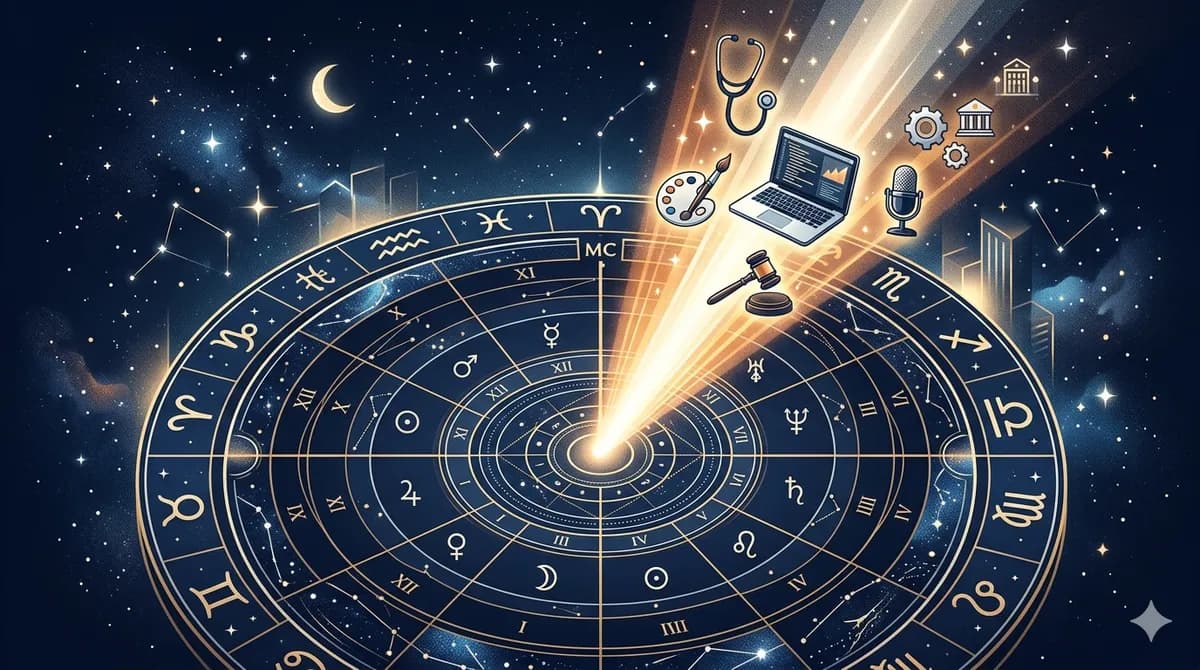
The Midheaven, or MC, is the cusp of the 10th House and represents the highest point in your birth chart. It symbolizes your public vocation, your professional reputation, and the image you project in the working world. It is, without a doubt, the most important vocational indicator.
The sign on the MC describes the style with which you present yourself professionally and the type of recognition you seek:
- MC in Aries: leadership, entrepreneurship, careers requiring initiative and courage. Military, athletes, entrepreneurs, surgeons.
- MC in Taurus: stability, working with tangible resources. Finance, gastronomy, agriculture, design, real estate.
- MC in Gemini: communication and versatility. Journalism, teaching, commerce, writing, public relations.
- MC in Cancer: care and nurturing. Psychology, gastronomy, social work, professional caregiving, history.
- MC in Leo: creativity and visible leadership. Performing arts, directing, entertainment, politics, fashion.
- MC in Virgo: service and precision. Medicine, research, data analysis, editing, nutrition, accounting.
- MC in Libra: harmony and relationships. Law, diplomacy, art, design, mediation, image consulting.
- MC in Scorpio: transformation and deep investigation. Psychology, surgery, criminal investigation, finance, therapy.
- MC in Sagittarius: expansion and teaching. Higher education, philosophy, travel, international trade, publishing.
- MC in Capricorn: structure and ambition. Business management, public administration, architecture, engineering.
- MC in Aquarius: innovation and community. Technology, science, humanitarian work, astrology, social media.
- MC in Pisces: intuition and compassionate service. Art, music, spirituality, photography, humanitarian work, film.
The MC Ruler: The Hidden Key
The planet that rules your MC sign is one of the most revealing and often underestimated vocational indicators. Its position by sign, house, and aspects shows how your career develops and what internal resources you have to achieve your professional goals.
For example, if your MC is in Libra, Venus is your MC ruler. If that Venus is in the 3rd House in Gemini, your vocation likely combines aesthetics and relationships with communication, writing, or teaching.
Analyzing the MC ruler requires considering several factors simultaneously:
- The house where the ruler is located: indicates the life area that feeds your career.
- The sign of the ruler: nuances the style with which you develop your vocation.
- The aspects it receives: planets in harmony facilitate professional development; planets in tension signal challenges that, once overcome, strengthen the career.
- Its essential dignity: an MC ruler in domicile or exaltation suggests a natural and flowing vocation; in detriment or fall, the career may require more conscious effort.
The 10th House: The Professional Stage
Planets located in the 10th House, if any, exert a direct influence on career:
- Sun in the 10th House: a vocation for leadership and public recognition. Career is central to identity.
- Moon in the 10th House: professions linked to caregiving, food, or the public. Career may fluctuate with emotional cycles.
- Mercury in the 10th House: intellectual careers, professional communication, commerce.
- Venus in the 10th House: artistic, aesthetic, or diplomatic professions. Success through charm and relationships.
- Mars in the 10th House: intense ambition, competitive or physical careers. Executive leadership.
- Jupiter in the 10th House: professional expansion, success in education, law, or internationalization.
- Saturn in the 10th House: a career built slowly but solidly. Authority earned over time.
The 6th House: Daily Work
While the 10th House speaks of vocation and career, the 6th House describes daily work, work routines, and the relationship with colleagues. A birth chart may show an elevated vocation in the 10th House but very different daily work in the 6th House, which explains the professional frustration many people experience.
The sign on the 6th House cusp and the planets inhabiting it reveal:
- Your ideal work style: whether you need structure or flexibility, teamwork or independence.
- Your relationship with occupational health: how professional stress affects your physical wellbeing.
- The type of work environment where you perform best: creative, analytical, social, or technical.
- Your attitude toward service: how you contribute to others' wellbeing through your daily labor.
When the 6th House and 10th House are thematically aligned, the person usually experiences deep professional satisfaction. When they conflict, there can be a persistent feeling that daily work does not reflect one's true mission.
The 2nd House: Resources and Income
The 2nd House indicates how you generate money and what natural talents you can monetize. Its analysis complements the vocational picture by showing the practical relationship between your abilities and your financial sustenance.
It is important to distinguish between vocation (10th House) and income source (2nd House). Ideally both are connected, but in practice many people earn money one way while their true vocation expresses itself in another realm. Vocational astrology helps identify how to unite these two worlds.
Saturn's Role in Career Development
Saturn deserves special attention in vocational astrology. As the planet of structure, discipline, and mastery, Saturn indicates where we must work hardest but also where we can achieve excellence over time.
Saturn's position by house and sign reveals:
- Where you face the greatest professional challenges: obstacles that, once overcome, become your greatest strength.
- Your style of authority: how you exercise leadership and how you relate to bosses and hierarchical structures.
- Your pace of professional maturation: Saturn favors long-term careers. Success may come later but is more lasting.
- Your relationship with responsibility: professions requiring sustained commitment are especially indicated.
The first Saturn return, around age 29, often marks a decisive moment in one's professional career: it is when many people change direction or finally commit to their true vocation. The second return, near age 58, brings another deep reevaluation that often coincides with the transition toward mentorship or consulting roles.
Transits and Career Evolution
The birth chart shows vocational potential, but planetary transits activate that potential at specific moments in life. Some particularly relevant career transits include:
- Transits to the MC or 10th House: any planet crossing your MC or aspecting the 10th House can bring significant professional changes. Jupiter brings expansion opportunities, Saturn demands restructuring, and Uranus can provoke radical and unexpected shifts.
- Pluto transits: when Pluto aspects your MC or planets in the 10th House, deep career transformations typically occur that, while intense, lead to greater alignment with your personal power.
- Eclipses on the 4-10 axis: eclipses touching your IC-Midheaven axis often coincide with moments of decision between personal and professional life.
- MC progressions: the progressed MC changes signs approximately every thirty years, marking new phases in professional orientation.
Beyond the MC: Complementary Indicators
A complete vocational interpretation also considers:
- North Node: indicates the direction of the soul's growth, which often manifests in one's vocation.
- Jupiter: shows where we have natural luck and ease of expansion.
- Stelliums (planet concentrations): if you have three or more planets in one house, that life area carries special weight in your vocation.
- Aspects between planets: connections between personal and transpersonal planets reveal unique talents.
How Artificial Intelligence Can Help
Vocational astrology requires synthesizing multiple factors simultaneously: the MC, its ruler, planets in relevant houses, aspects, and current transits. This complexity is precisely where artificial intelligence demonstrates its value.
At Aspectados, our AI specialized in astrology can analyze all these indicators in an integrated way, identifying vocational patterns that might go unnoticed in a manual reading. The analysis considers not only your static birth chart but also the current transits that may be activating your professional potential.
Some advantages of AI-powered vocational analysis:
- Instant synthesis of dozens of astrological factors that interact with each other.
- Detection of subtle patterns connecting different chart areas with professional implications.
- Personalized interpretation that accounts for your complete chart configuration, not just isolated elements.
- Transit tracking that identifies the best moments to make career decisions.
Practical Examples of Vocational Reading
To illustrate how vocational astrology works in practice, consider some examples:
Example 1: A person with MC in Aquarius, Uranus (MC ruler) in the 5th House in Scorpio, and Mercury conjunct the MC. This configuration suggests a vocation in creative technology, artistic innovation, or disruptive digital communication. The Scorpio component adds investigative depth to the work.
Example 2: Someone with MC in Cancer, Moon (MC ruler) in the 6th House in Sagittarius, and Neptune in the 10th House. This chart points to caregiving vocations with an international or philosophical component: humanitarian work, cross-cultural psychology, or integrative medicine.
Example 3: A chart with MC in Capricorn, Saturn in the 2nd House in Gemini, and a stellium in the 10th House. This configuration indicates a career oriented toward structure and management, with ability to generate income through communication and a strong public professional presence.
Common Mistakes in Vocational Astrology
When exploring the vocational indicators in your chart, it is important to avoid certain frequent misunderstandings:
- Reducing vocation to a single factor: career does not depend solely on the MC. It is the integration of multiple indicators that offers a clear picture.
- Interpreting signs too literally: having MC in Virgo does not necessarily mean you should be a doctor. It means your professional style tends toward precision, analysis, and service, qualities applicable across many fields.
- Ignoring transpersonal planets: Uranus, Neptune, and Pluto aspecting the MC or 10th House can indicate unconventional or generational vocations that make a difference.
- Forgetting that the chart evolves: transits and progressions activate different vocational potentials throughout life. What fulfilled you at 25 may not be the same at 45.
Find Your Professional Path
Vocational astrology does not replace your decision-making ability nor limit your options. On the contrary, it broadens your perspective by showing you natural inclinations you may not have considered and by confirming intuitions you already had about your professional direction.
Your birth chart is a map of possibilities, not limitations. Each vocational indicator represents a potential that can develop in multiple ways depending on your circumstances, your education, and your conscious decisions. Astrology illuminates the path, but it is you who walks it.
If you feel that your career does not reflect who you truly are, or if you are at a moment of professional transition, we invite you to explore the vocational indicators in your birth chart at Aspectados. Our artificial intelligence can help you discover the astrological keys to your professional purpose and make decisions more aligned with your true nature.