Applying and Separating Aspects: Orbs, Timing and Why Direction Matters
Applying and Separating Aspects: Orbs, Timing and Why Direction Matters
When you look at a birth chart, you see lines connecting planets: trines, squares, oppositions. But there is one detail that many interpretations overlook and that completely changes the reading: whether the aspect is forming or dissolving. Astrologers call these applying aspects and separating aspects, and understanding them will help you read charts with far more precision. At Aspectados we explain them clearly, together with the essential concept of the orb.
What Applying and Separating Aspects Represent in Astrology
An aspect is an angular relationship between two planets. Its direction adds an extra layer of meaning:
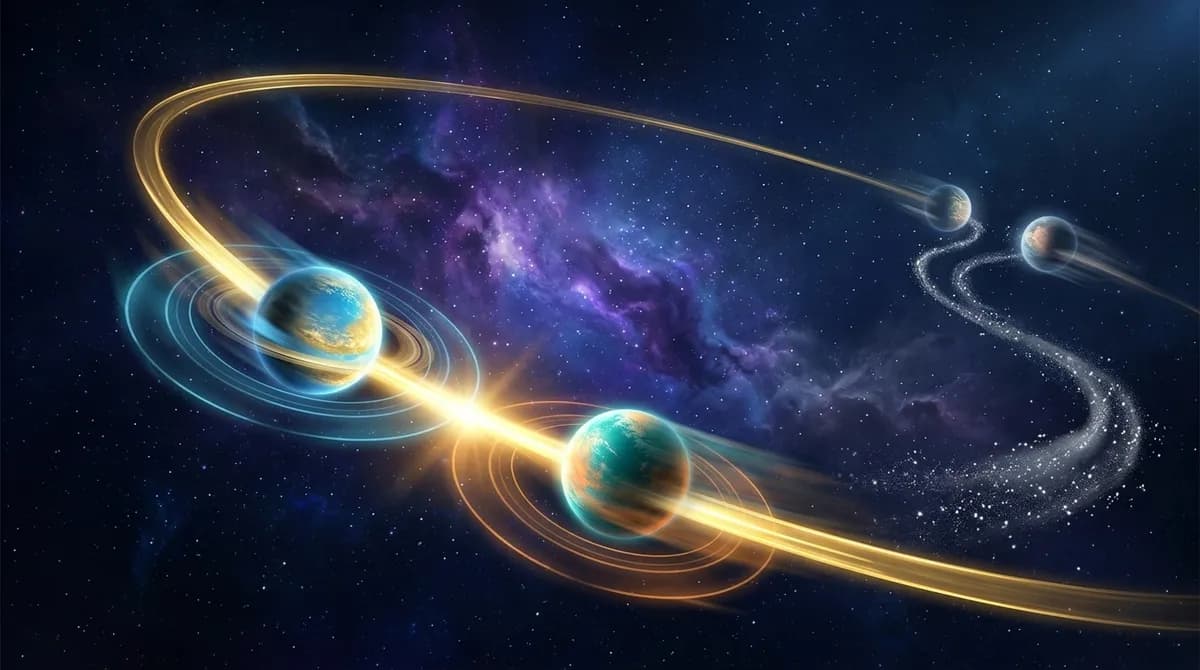
- Applying aspect: the faster planet is moving toward the exact degree of the aspect. The energy is building and has not yet peaked.
- Separating aspect: the faster planet has already passed the exact degree and is moving away. The energy is waning or has already been lived through.
- Exact (partile) aspect: both planets sit at the same degree of the aspect. This is the point of maximum intensity.
- The orb: the range of degrees within which we consider an aspect to be active.
- Timing: in predictive and horary astrology, direction indicates whether an event is still coming or has already happened.
How to Tell Whether an Aspect Is Applying or Separating
The faster planet leads
Always look at the faster planet. The approximate order of speed is: Moon, Mercury, Venus, Sun, Mars, Jupiter, Saturn, Uranus, Neptune and Pluto. If the Moon is at 10° Taurus and Saturn at 14° Taurus, the Moon is heading toward Saturn: that is an applying conjunction with a 4° orb.
An example of separation
If Venus is at 18° Leo and Mars at 15° Scorpio, there is a square with 3° between them. Venus is faster and has already passed the exact point (15° Leo), so the square is separating.
The retrograde twist
Retrograde motion complicates the rule. A retrograde planet can reapply to an aspect it was separating from. For example, during Mercury's retrograde in Scorpio from October 24 to November 13, 2026, Mercury will redo aspects it had already formed. That is why retrogrades are associated with reviews and issues that come back around.
Mutual application
When one planet is direct and the other retrograde, both may move toward each other. Traditional astrologers considered this mutual application especially swift and decisive.
What Orbs Are and How Wide They Should Be
Orbs by aspect
There is no universal rule, but a widely used modern reference is:
- Conjunction and opposition: up to 8°-10°.
- Trine and square: up to 6°-8°.
- Sextile: up to 4°-6°.
- Minor aspects (semi-square, quincunx, sesquiquadrate): 1°-3°.
Orbs by planet
Medieval tradition assigned orbs to each planet rather than to each aspect. The Sun and Moon had the widest orbs, while the slower planets had narrower ones. Many astrologers still widen the orb whenever a luminary is involved.
Wider orbs when applying
A common practice is to allow more orb for applying aspects than for separating ones. The logic is intuitive: what is approaching can already be felt, while what is moving away gradually loses strength.
Out-of-sign aspects
An aspect can fall within orb but between signs that do not match. For example, 29° Aries and 2° Leo are 93° apart: by degree it is a square with a 3° orb, yet Aries and Leo are signs in trine. This is an out-of-sign square, sometimes called a dissociate aspect. Many astrologers consider it valid but weaker or "disguised."
Why Direction Matters in Interpretation
In the birth chart
Some astrologers associate applying aspects with themes that unfold over a lifetime: something the person gradually discovers and builds. Separating aspects are linked to more innate abilities or to patterns that feel "already familiar," almost inherited.
In horary astrology
Here, direction is fundamental. If the ruler of the person asking applies to an aspect with the ruler of the matter asked about, tradition reads it as a sign that the matter can come to fruition. If the aspects separate, the matter is usually interpreted as already past or lacking continuity.
In transits and progressions
An applying transit is a period of build-up: tension or opportunity increases. The exact moment tends to coincide with the peak, and the separating phase with integration. Many astrologers note that transits are often felt before they become exact.
In lunations
At a New or Full Moon, the aspects the Moon will form over the following days (applying) are associated with how the lunar cycle develops, while the separating ones describe what is coming to a close.
A complete example
Imagine a chart with the Sun at 12° Cancer and Saturn at 15° Libra. There is a square with a 3° orb, and since the Sun is faster and has not yet reached the exact point (15° Cancer), it is applying. Many astrologers would read it as a challenge around responsibility and structure that the person gradually matures into over the years. If the Sun were at 18° Cancer, the same square would be separating: a lesson that feels more internalized, almost like a starting point rather than a destination.
Practical Tips for Your Readings
- Always check the degrees, not just the signs. Two planets in the same sign are not always in a meaningful aspect.
- Identify the faster planet before deciding whether an aspect applies or separates.
- Rank aspects by orb: the tightest ones tend to be the most visible in a person's life.
- Watch for retrogrades, which can reverse the direction of an aspect.
- Be consistent with your orbs: choose a criterion and keep it across all your readings so you can compare charts fairly.
- Combine technique and intuition: a tight separating aspect can be more relevant than a wide applying one.
Conclusion
Applying and separating aspects add time and movement to a chart that, at first glance, looks static. Knowing whether an energy is growing or dissolving, and how much orb to allow it, lets you refine your interpretations and better understand the rhythm of transits. If you want to see which aspects in your chart are applying and which are separating, calculate your birth chart on Aspectados and ask our AI-powered astrologer: it will help you interpret each aspect with its orb and its direction.