Antiscia and Contra-Antiscia: The Hidden Aspects Mirrored by the Solstices
When we look at a birth chart, we usually search for conjunctions, oppositions, trines and squares. Yet traditional astrology knows another kind of connection between planets that most software does not show by default: antiscia and contra-antiscia. Two planets can be linked without forming any classical aspect, simply because they are mirror images of each other across the solstice axis. At Aspectados we explain what they are, how to calculate them step by step and how to interpret them in your chart.
What Antiscia Represent in Astrology
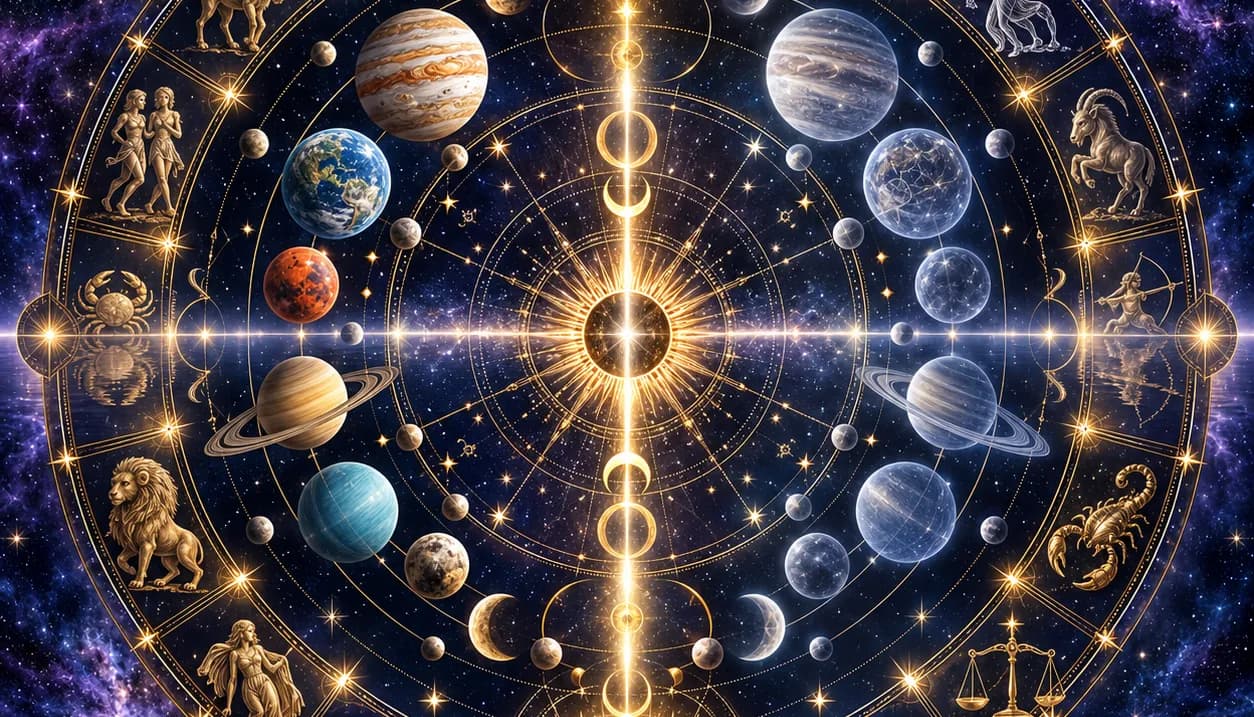
The word antiscia comes from Greek and means "opposite shadows". The idea starts from something very concrete: the length of the day. Two points of the zodiac at the same distance from the Cancer–Capricorn axis (the solstices) receive the same amount of daylight when the Sun passes through them. That is why they are considered "twins" in light. Their symbolism includes:
- Hidden connection: a bond between planets that is not obvious at first glance.
- Reflection and mirroring: one planet "sees itself" in the other, as if they shared a shadow.
- Discreet affinity: traditionally compared to a conjunction or a harmonious aspect, only subtler.
- Latent tension (in the case of contra-antiscia): an opposition-like relationship working behind the scenes.
- Extra information: in horary and natal astrology, antiscia can explain events that visible aspects do not account for.
The technique goes back to antiquity: Ptolemy speaks of signs that "behold" each other, and Firmicus Maternus develops antiscia at length in his Mathesis (4th century). Centuries later, William Lilly used them often in Christian Astrology (1647), especially in horary questions.
How to Calculate Antiscia and Contra-Antiscia
The mirror rule
The reference axis runs from 0° Cancer to 0° Capricorn. Each sign has a mirror sign on the other side of that axis, and the degree is found by subtracting the original degree from 30. The formula is simple: antiscion degree = 30° − original degree. For example, a planet at 10° Aries has its antiscion at 20° Virgo. If you work with minutes, subtract from 30°00': a planet at 12°20' Taurus casts its antiscion to 17°40' Leo.
Mirror sign table (antiscia)
- Gemini ↔ Cancer
- Taurus ↔ Leo
- Aries ↔ Virgo
- Pisces ↔ Libra
- Aquarius ↔ Scorpio
- Capricorn ↔ Sagittarius
Notice that each pair sits at the same distance from a solstice point: Gemini and Cancer surround it immediately, Taurus and Leo one sign further out, and so on.
Contra-antiscia
The contra-antiscion is the mirror across the Aries–Libra axis (the equinoxes). In practice, you just take the point opposite the antiscion. If the antiscion of 10° Aries is 20° Virgo, its contra-antiscion is 20° Pisces. The contra-antiscial sign pairs are: Aries–Pisces, Taurus–Aquarius, Gemini–Capricorn, Cancer–Sagittarius, Leo–Scorpio and Virgo–Libra. These signs share equal rising times on the horizon, another classical form of "kinship".
Orbs
Antiscia work with very tight orbs. Most traditional astrologers only consider them active if the planet falls within 1° to 2° of the mirror point. Some modern authors allow a little more, but the more exact the reflection, the more weight the interpretation carries.
A worked example
Imagine a chart with Mars at 8°15' Scorpio and Saturn at 21°30' Aquarius. At first glance they form a loose square, nothing special. But Scorpio mirrors Aquarius, and 30°00' − 8°15' = 21°45'. So Mars casts its antiscion to 21°45' Aquarius, just fifteen minutes from Saturn. Suddenly that "loose" square becomes a tight, hidden union of the two traditional malefics, worth noting when you study themes of discipline, conflict or effort in that person's life.
How to Interpret Antiscia in the Birth Chart
Antiscion: a veiled conjunction
When a planet touches another planet's antiscion, tradition treats it much like a conjunction or a friendly aspect: the two principles cooperate and blend. The difference is that the connection is more private, less visible to others and sometimes even to the native. For instance, Venus in antiscion with Jupiter may point to good fortune in love that conventional aspects do not reveal.
Contra-antiscion: a hidden opposition
The contra-antiscion has historically been read as something akin to an opposition or square. Lilly considered it more difficult in nature. Here traditions disagree: some contemporary astrologers read it simply as a polarity link without a necessarily negative charge, while others keep the classical reading of tension. The sensible approach is to weigh it according to the nature of the planets involved.
Antiscia and the angles
Planetary antiscia falling on the Ascendant, the Midheaven or their opposite points are especially significant. A planet that exactly mirrors the Ascendant can act almost as if it were conjunct it, coloring personality and physical constitution.
Antiscia in transits and returns
The technique is not limited to the natal chart. Transits over the antiscion of a natal planet can trigger its themes, and in solar returns or horary charts the mirror points often explain unexpected turns. Many horary astrologers always check antiscia before giving a judgment.
Practical Tips for Using Antiscia
- List your planets with exact degrees and minutes.
- Calculate each antiscion using 30° minus the degree and the mirror sign table.
- Look for matches with other planets or angles within 1° to 2°.
- Calculate the contra-antiscia too, by taking the opposite point.
- Interpret in context: consider dignities, houses and rulerships, just as you would with any aspect.
- Do not overstate them: antiscia complement classical aspects rather than replacing them. Use them as an extra layer of nuance.
A good exercise is to review key moments in your life and check whether a transit was touching the antiscion of a natal planet. Many people discover connections this way that previously had no explanation.
Conclusion
Antiscia and contra-antiscia are one of the gems of traditional astrology: an elegant system born from observing sunlight that reveals hidden connections between planets. Although they require tight orbs and a little arithmetic, they add remarkable depth to chart reading. If you want to explore your birth chart in detail, see your exact positions and go deeper into techniques like this one, visit Aspectados, the AI-powered astrology platform that helps you interpret your chart and transits with rigor and clarity.